


 Apple Podcasts
 Spotify
 YouTube
 2024 Year in Review. Pt. 6
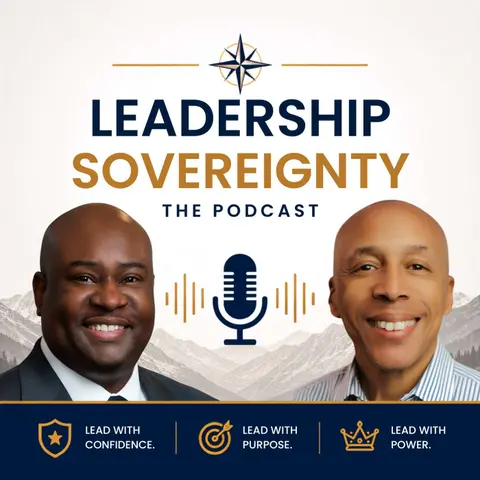
This episode explores the transformative power of reading and how it connects us to the wisdom of giants who came before us. We delve into the profound impact that books can have, offering us a glimpse into the minds of successful individuals across history and various fields.
★ Support this podcast ★Welcome to a year end review of Leadership Sovereignty, the podcast. I'm your host Ralph Owens along with Terry Baylor. In this readable episode, Terry and I focus on the concept of standing on the shoulders of giants through reading books. We talk about the exposure to the mind of the successful through books and the impact of leadership on your life. Enjoy the show.
Speaker 2:Hello, and thank you for joining Leadership Sovereignty. I'm your host, Terry Baylor, along with Ralph Owens. In today's episode, we're going to discuss standing on the shoulders of giants. In that today is a special day. We show honor to Doctor.
Speaker 2:Martin Luther King. Enjoy the show.
Speaker 1:That leadership company that I joined, it basically framed what leadership was for me. I started to see it in other people, but I couldn't put a title on it. I didn't know what it was called. When I got into that organization, then I knew exactly what it was that I had been seeing all of this time because it didn't matter at that point if you were white or if you were black, if you understood the concepts and you apply them, you got the same result. And then that's when I really started digging into the books.
Speaker 1:And I just can't say it enough for those in our community, the ability to read. I've heard it say it this way. This is probably the best way to say it. When you read a book, you stand on the shoulders of giants. You get an opportunity to take advantage of the best of a person's life.
Speaker 1:Let's say a person lived for a hundred years and they wrote a book on all the successes and failures. You get a chance to take the successes that that person did and avoid their failures all by reading one book. Right? It took them a hundred years to be able to get to those experiences, but you get to you get to take advantage of them by reading one book. So you stand on the shoulders of giants when you read a book and most of the information that you're gonna need to be successful, especially in corporate America and business, you're not gonna find just searching the internet.
Speaker 1:You're not gonna find just talking to other people. A lot of times you gotta get into these books because and going back to that one point about exposure, right? If you wanna learn how to make a million dollars, you need to talk to a millionaire because he's already done it. If you're talking to people who had never done it before, then you're talking about theory. You wanna talk to somebody who's already done it.
Speaker 1:Well, maybe you're not in a situation where you can meet a millionaire, but you can read a book written by a millionaire. It allows you to get the exposure into how they think so that you can start to think the same way.
Speaker 3:I totally agree with that. So my oldest son Terrence, he plays basketball. And one of the books I bought him was that Kobe Bryant book, you know, the Mamba Mentality. And one of the biggest things he took away from that book, you know, we all know Kobe worked hard and he was just relentless. The biggest thing to ran.
Speaker 3:So one of the biggest things he took away from that book was, he said, Dad, Kobe felt butterflies before each game too. He said, You know, when I felt that I thought it was fear. So when I went into the game, in my mind, I thought I was scared. He said no that's that's just the nervous energy of the game. He said so I totally he said after I get in and I make my first pass or I make my first shot then it's gone.
Speaker 3:He said, but I he translated that emotion as fear. But, no, it was just anticipation on what was, going to happen or what you were expecting to do. It totally transformed. He said, dad, I've been playing like that for the last two and three years. To your point, he was able to take Kobe's what 1819, wherever many years he played in the league Mhmm.
Speaker 3:And took that one valuable lesson
Speaker 1:Mhmm.
Speaker 3:And transformed how he saw himself going into the game games down and transform his expectation of himself and what he thought about himself. Mhmm. Right? Before going to the game. But if not if we hadn't bought that book, if he hadn't read Mhmm.
Speaker 3:Then probably today, he wouldn't be having the successes that he's having today.
Speaker 1:That's it, man. That and then that's that's that's the whole point of understanding exposure. Right? And I think that's kinda what we are leading into today is exposure to leadership, exposure to how you get that leadership because it's gonna change your life. It's gonna change how you do your day to day.
Speaker 1:It's gonna change how you interact with people. It may even change how you interact if married with your spouse, with your children. It changes everything. But until you're exposed, you just don't know how it's gonna change you. So I mean, the power of reading books is just you can't say enough about it.
Speaker 1:Yeah.
Speaker 3:And to your point, right? You as a leader, it's greater than what you do at work. What understand and what you will begin to understand is that it impacts every place you go, everything you do, every encounter, every interaction, how you lead impacts your life.
Speaker 1:Yes. Yes. You never turn it off. It's not something you turn on just to get something and then you turn it off when you wanna become back to your normal self. It is who you become.
Speaker 1:It's about the journey. It's about the transformation of you as an individual. All the other things that come as a byproduct are just that they're just byproducts of who you're becoming because of your exposure to leadership, your choice to actually interpret and understand what it is that you're reading and then applying it. Right? Cause it's not just about having the books.
Speaker 1:There were times where I just had books on the shelf, but I never read them. Good is that gonna do me? Right? Not only do I have to get the book to be exposed to, but I gotta read it. I gotta understand what it says and then I have to apply it into my own life.
Speaker 1:But by doing that, we have been able to achieve successes that I know for a fact, no one else in my family has been able to do at this point. God has really been able to bless us to get to a certain place that is kind of uncharted territory for my family. And we just getting started, right? And where we're going. So I cannot be thankful enough for you, the relationship with you because we've been riding through this thing for a while now.
Speaker 1:Learning these leadership lessons along the way and applying them in our professional and personal lives and seeing the results of it, seeing the fruit of
Speaker 3:So this is what we've kind of come up with and it's a work in progress. So let me read this for the audience. Leadership Sovereignty, discussions about leading unapologetically from a position of influence, knowledge, wealth, and power as African American men and men of color.
Speaker 1:That's good.
Speaker 3:What do you think about that?
Speaker 1:I think it's perfect. Yep. Yep. I think that's perfect. I think that's perfect.
Speaker 3:Yeah. Ralph, I'm I'm so sorry. Go ahead.
Speaker 1:I was just gonna ask. So, you know, what was some of you where did your leadership journey begin, in your life?
Speaker 3:So that's interesting, man. I I honestly, I cannot remember a time that I wasn't leading. And again, I think that comes from seeing my dad, seeing my brother. So just a little bit of background, right? I am the sixth of seven boys.
Speaker 3:So my parents had essentially five boys in a row. Then they took a break. Then there came me. There was a seven year gap. Then there was a six year gap and came my brother Marcus.
Speaker 3:Now I don't want to, you know, shortchange my sisters. I have two sisters and they are the bookends. So essentially, my parents had six kids in a row. My oldest sibling is Diane. There was a break, then there came me.
Speaker 3:Twila was actually no, Twila is not the bookend Marcus is the bookend, but Twila and I are you apart. And then there's six years between Twila and Marcus. So But again, I've seen this leadership to answer your question. Growing up, I played sports. I found myself always being a captain on a team.
Speaker 3:But my leadership was really kind of, I'll say, one dimensional, in that it was around sports. And again, we learn a lot of great skill sets, you know, in leading people. And one of the things I flourished at is understanding people, understanding the dynamic of, you know, leading a team. And then when I got a little older in my teenage years, I had a vocal group, I was the lead man for that group. When I went to college, was in a vocal group, I was the lead man for that group.
Speaker 3:So kind of the things that I had been accustomed to. And then actually, as a 13 year old or 14 year old, I coached the baseball team. So again, this leadership understanding the human dynamic, I think the thing that was missing though in my leadership that I had to learn was the dynamic of corporate leadership and understanding that when you're in corporate the team isn't always unified because in sports most times that team is typically always unified but in corporate America you have multiple teams So that dynamic man was an eye opening experience for me. And I'll be quite just really transparent. My first experience to it, I didn't handle it well.
Speaker 3:I did not handle it well. I didn't understand the politics. I didn't understand the nuance of smoke and mirrors. And all of that. I didn't understand the power that I had and my influence.
Speaker 2:Thank you for being with us today on Leadership Sovereignty. Stay connected with us on X, formerly known as Twitter, and on Instagram by searching for Leadership Sovereignty. And just like this podcast, let's all collectively grow as we go. God bless.