
 Apple Podcasts
 Spotify
 YouTube
 Effective Leadership. Pt. 6
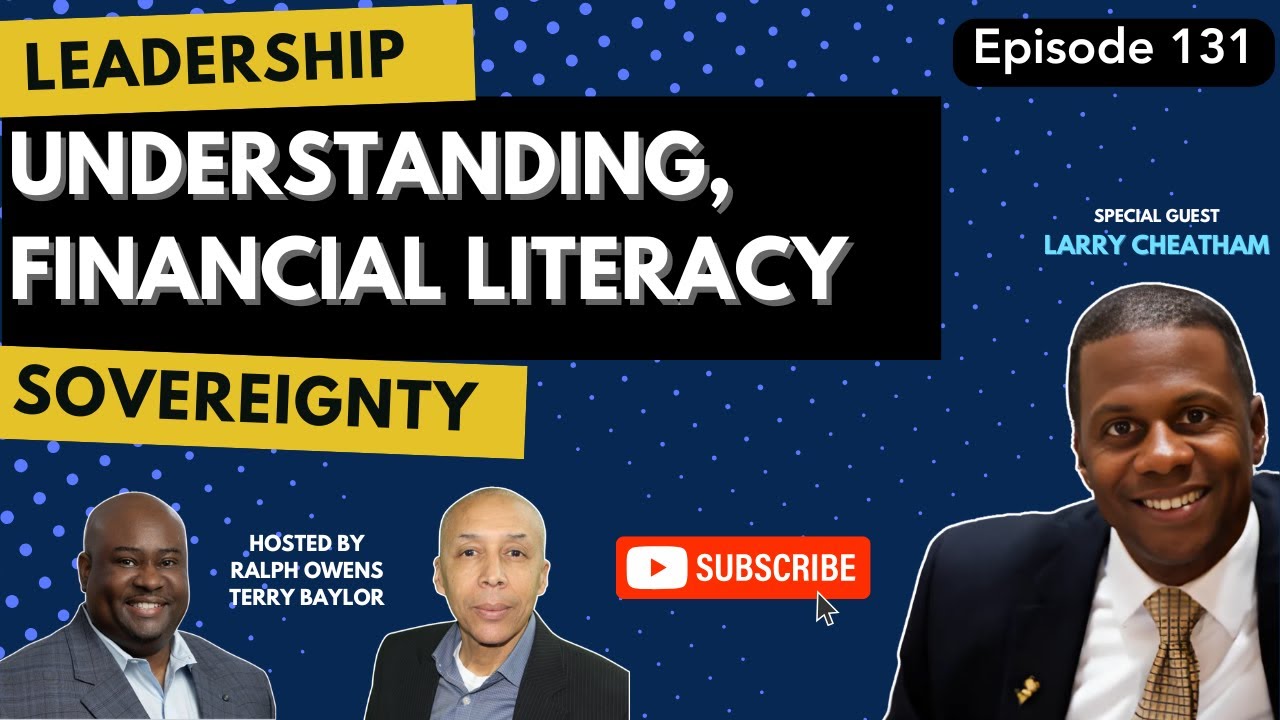
In this episode of Leadership Sovereignty, hosts Terry Baylor and Ralph Owens engage with Larry Cheatham to discuss the critical importance of financial literacy in leadership. They explore how understanding financial principles can empower individuals to achieve their dreams and goals, highlighting the disparities in tax burdens between different types of earners. The conversation emphasizes the need for financial education to break free from economic bondage and offers practical resources for listeners to enhance their financial knowledge.
Takeaways
- Never chase money; chase significance.
- Financial literacy is essential for leadership.
- Being in debt can lead to economic bondage.
- There are three aspects to financial literacy: offense, defense, and playing field.
- Understanding taxes can significantly impact your finances.
- Big businesses often pay less in taxes legally.
- The tax code incentivizes certain behaviors.
- Financial literacy can change your financial future.
- You need to learn the rules of the financial game.
- Practical resources are available for improving financial literacy.
Chapters
00:00 Leadership and Financial Literacy
01:1 5Understanding Financial Literacy
07:41 Practical Steps to Financial Freedom
★ Support this podcast ★If you're if you don't learn financial literacy, find that you find yourself in bondage. It's it's kind of the new slavery, so to speak.
Speaker 2:Welcome to Leadership Sovereignty. I'm your host, Terry Baylor, along with Ralph Owens. And today, Larry Cheatham discusses financial literacy. Understand why you're paying 40 to 60% in taxes and why big business and system owners pay 20 to 0%. Enjoy the show.
Speaker 1:Yeah. And what I was going to say, Terry, was that one of the things I've learned over time, never chase money. Chase significance. You chase significance, money will always find you.
Speaker 3:Yeah. Oh, that's that's good. That's good. That's good. I think, so so let's let's talk a little bit about then why financial literacy is a critical component of leadership and your ability to get to your dreams and your goals, because that's not something that's talked about at the kitchen table is definitely not, at least when we were in school, wasn't not talked about in school.
Speaker 3:You know, talk a little bit about the importance of financial literacy.
Speaker 1:Yeah. Listen. If you're if you don't learn financial literacy, find that you find yourself in bondage. It's it's kind of the new slavery, so to speak, although I don't know how new it is at this point. Mhmm.
Speaker 1:And so if you can actually if you can actually get someone to actually go into debt, right, you now have They they have to go to work and give their time to somebody else because they owe. They're they're indebted, you know, to someone else and they have no choice, you know, but some they say, my daughter's sick. I I gotta go to the hospital. Oh, well, we may have to let you go if you can't show up, you know, or, you know, man, you know, I don't I don't wanna miss my kids, you know, recital. I don't wanna miss their ballgame.
Speaker 1:Oh, yeah. Well, I'm sorry, but you carry your buckets for us. Mhmm. You know? Mhmm.
Speaker 1:And so you become enslaved because you've actually put yourself in bondage. Mhmm. So financial literacy is key. And let me say this also in respect to financial literacy because in my mind, and again, I learned this, is that there's three aspects to financial literacy. Mhmm.
Speaker 1:There's offense. How do you think about making money and bringing it in? Because you can also get weird about offense, right? You can make making money the center of your life and you can neglect things that are more important like your faith walk in your family.
Speaker 3:Right.
Speaker 1:As an example. Right. So, but it's important nonetheless, just not more important than those things. So you got to get it right. And so offense, there's a defense.
Speaker 1:How do you think around defending, you know, your finances? You know, you can do that right or you can get weird about it. Right?
Speaker 3:Mhmm.
Speaker 1:You can be the uptight person in your household. I always I stole this from a guy named Chris Brady trying to convince everybody else. We need to conserve, so I'm gonna need you to use both sides of the toilet paper.
Speaker 2:You know, that would make
Speaker 1:you weird, you know? Or you say, oh, I don't turn I don't turn the air conditioning on before July 1. It's June 30 and it's 105 degrees outside, you know, that would make you weird. So yes, you have to play defense, but you can't get weird about it. And then finally, we call it the playing field, the rules of the game, right?
Speaker 1:Yeah. How will taxes impact you? How will a stable economy impact you in in inflation? Or are there things you can do about it
Speaker 3:Mhmm.
Speaker 1:Once you understand the rules? Right? And and mentioning the rules, right, when we were talking about ESBI Mhmm. This is something that I I also discovered that makes it very difficult when you're on the left side of the cash flow quadrant to win. Mhmm.
Speaker 1:That you know that if you look at employees, right, they pay as much of as 40% of their income and taxes. Mhmm. If you look at the s type business owner, I used to think that they paid less than the employee because they had tax advantages. Mhmm. But no, they pay as much as 60%
Speaker 3:Mhmm.
Speaker 1:Of their money in taxes. And there's as many as 97 different taxes in in the tax code. Mhmm. You know? But if you look at the B type business owner and the I type Mhmm.
Speaker 1:They pay as little as in the B type as little as 20%.
Speaker 2:Mhmm.
Speaker 1:Wow. And as little as zero in the I quadrant. And I pointed out that that Amazon in 2016, profits was over $5,000,000,000, but yet they pay zero in federal taxes.
Speaker 3:Mhmm.
Speaker 1:And they're they doubled their profits from 2016 to 2017. So I said double. Remember, over 5,000,000,000 in profits in 2016. This one thing when you double and you make a 100,000. Mhmm.
Speaker 1:This is one thing when you double and it's a million. Mhmm. It's one thing when you double and it's a billion. Mhmm. But it was 5,000,000,000.
Speaker 1:Mhmm. And they doubled it in 2017 and they paid zero in federal taxes.
Speaker 2:Wow.
Speaker 1:Now they went up by measly one point, I believe it's one point some billion dollars the following year, like 2018. They finally paid taxes, federal taxes, 1.2%. So you understand, as long as you play the game
Speaker 3:Mhmm.
Speaker 1:On the left side and you're gonna give away 40 to 60% of your money in taxes and the other side is giving away 20 to zero legally.
Speaker 3:Legally,
Speaker 1:they're not doing anything illegal.
Speaker 3:That's right. That's right. Legally. Let's touch, let's touch on that for a second. Right.
Speaker 3:Because, know, popular opinion out there is that, you know, Oh, that was a big companies they're doing. They're, they're cheating, you know, these things, right? The things that we've learned is this. The tax code was written to incentivize what the government wants. What does that mean?
Speaker 3:Correct. That means that the government wants the industry to build homes for people, to create jobs for people, they give incentives for companies or entities that do that. This is the reason why these entities don't pay taxes. It's not because they're cheating. It's because they're doing what the government says in the tax code.
Speaker 3:And then as a result, they get a benefit from it. The reason why the W2 employee doesn't get it because you're not doing what the tax code wants you to do. Right. Other than to pay it to the systems. Right.
Speaker 3:So again, but that comes with financial literacy. If you, if you only watch what's on TV and you take the popular opinion without really understanding how it actually works, you know, you will be thinking that, oh, you know, these, these billionaires, they made all this money and they didn't have to pay any taxes and they're crooks. No, they understand the tax code and you don't. Right. This is why financial literacy, if a person could, can pay 60% of everything and they make in taxes.
Speaker 3:That could be the difference between, a person who pays zero and what it is is financial literacy. Right?
Speaker 1:Right. Exactly. Right. The back to the playing field, right? The rules of the game.
Speaker 1:So what those people have learned to do is to play the rules. Yes. Literally playing by the rules. Mhmm. The only reason we've not been playing by the rules for so many years, I I, again, I, today, I play by a completely different set of rules because I've been learning, you know, I shouldn't say by a different set of rules.
Speaker 1:I play by the same rules that they play by. I just learned how to implement the rules, you know? And so you gotta get your hands on the right information at the end of the day. And then you gotta take action.
Speaker 2:So Larry, what is something tangible that folks can walk away with from today's session and they can get that early redirection that we were talking about.
Speaker 1:Yeah. Well, we're talking about financial literacy. If they were looking for that, then there's something called the financial fitness program that is probably one of the handful of programs I've actually used that would focus on all three of those areas, the offense, the defense, and the playing field of personal finances. There's another book that not too long ago came out called, The Rise of the Financial Matrix and the Fall of Economic Freedom. And it's a deep read, but it's one that will, as you read it, it exposing a very dark underbelly that exists in this world of elites that are taking advantage of the masses.
Speaker 1:It will make you angry, frankly, as you read it. But as you get closer toward the end of the book, it begins to discuss solutions. Mhmm. What can be done about what's taking place? You know?
Speaker 1:And then ultimately, listen, this is what I do for a living today. This is all I do, you
Speaker 3:know,
Speaker 1:for a living, frankly, today is I look for those people who are looking for a way out. Mhmm. And then what I do is I say, oh, I'm gonna show you. I say, you may not choose to take advantage of what I teach, but you'll never ever be able to say you've never seen a way out. You won't be able to do that, you know?
Speaker 1:And so I would tell those people, you know, to just reach out to me at Larry Cheatham dot com, you know, and there's a way for them to request, you know, we're actually right now in the process of launching a campaign and that campaign is going to be done both live. There'd be two separate campaigns, so it's a dual campaign. It'll be done live and it will be one done virtually later on. And, but what anyone who reaches out now, they'll be able to get a head start and connect with me and learn much around what I'm teaching people around the country. I And don't know if you can see my spelling of my name on the screen, Cheatham.
Speaker 1:And so if they just go to larrycheatham.com, they can request personal time and I'll put something on the calendar
Speaker 2:for some assistance. So on that, I just want to say this real quick, right? So as we were kind of talking through systems and what all the money that these financial institutions are making, right? You got to understand, language is everything. And so, you know, the redefining of words, right?
Speaker 2:I remember growing up and hearing people when they got a mortgage, they were excited about it. I got a mortgage. Yes. They gave me so so so let me help everybody out here. Right?
Speaker 2:I said, well, what is the root meaning of mortgage? Mort means death.
Speaker 1:That's right.
Speaker 2:Right? Gage means pledge. So we've now been we've been celebrating the death pledge.
Speaker 1:And I believe if you look the Latin meaning of gauge, it would mean grip.
Speaker 2:Oh my gosh.
Speaker 1:Death grip.
Speaker 2:Wow. And we've been celebrating this, like, know, thanking God for it. I mean, I get it. I get it. Right?
Speaker 2:I understand that because certain tools throughout history, certain folks, whether it was from a class system, socio economical, racial, whatever it is, right, you weren't allowed access to certain financial tools. And then when you got access to those tools, it was a big deal. So I understand that. But we have to understand what the root, what the whole purpose of that tool was for. Right?
Speaker 2:And unless we understand, again, because, you know, we're gonna have to leverage those tools, but we have to understand how to best manage them. Go ahead, Larry.
Speaker 1:No. I was gonna say, you know, everything that you're saying, I I just kinda thinking through a lot of this stuff in my own life and, you know, how many of it how much of it that I did get wrong. Right? And how much of it for fortunately, to God be the glory Mhmm. I got corrected.
Speaker 2:Thanks for tuning into Leadership Sovereignty. If you found value in today's episode, be sure to follow, like, and share. Your support helps us keep the conversation going. Until next time, lead with purpose and God bless.
Entrepreneur | Business Leader
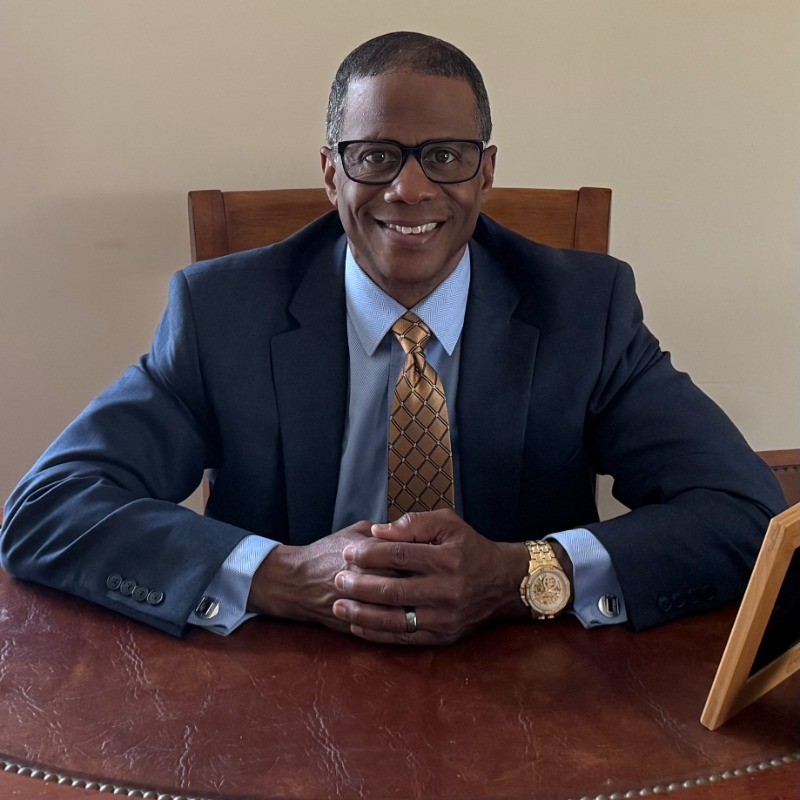
Larry Cheatham is the President of Global AO Solutions, where he is dedicated to helping individuals and businesses achieve financial freedom and create a lasting positive impact. With a proven track record in executive leadership and business development, Larry specializes in transforming operational excellence into sustainable growth and long-term success.
Passionate about empowering others, he combines strategic vision, innovative solutions, and hands-on mentorship to drive results across diverse industries. Larry’s commitment to elevating people and organizations reflects his core belief that purposeful leadership can change lives and communities for the better.