


 Apple Podcasts
 Spotify
 YouTube
 Hero of Their Role: How to Get Team Buy-In on Project Management Without Chasing Updates
Key Takeaways
- Traditional project management tools often fail because they are designed for executive dashboards rather than the individuals doing the daily work, turning the software into a glorified reporting function.
- Sai Prakash explains that the core philosophy behind MindStaq is to center product design around the human user, ensuring that the software makes the individual's day better instead of acting as an administrative burden.
- When rolling out a new work management tool, leaders must focus on a human-first narrative that shows employees how the platform helps them excel at what they do, avoiding the perception of micromanagement.
- Artificial intelligence in work management should be utilized as an assistant to enhance human capability and automatically log routine tasks, rather than trying to completely replace human roles and judgment.
Why won't your team keep the project tool updated, and what would make them want to?
Most project management tools fail the same way. The team stops updating them, the manager starts chasing status, and the tool becomes a report nobody wants to feed.
Sai Prakash, CTO and co-founder of MindStaq, returns to The Leadership Sovereignty Podcast with host Ralph E. Owens II and co-host Terry Baylor, and this conversation continues the one that began in the last episode. Sai has spent more than 25 years in technology and product leadership, including six years at Microsoft and roles at Thomson Reuters.
His argument is that the software was aimed at the wrong person. "The software wasn't designed for them, it was designed for the company." A tool built so an executive's dashboard can light up gives the person doing the work no reason to engage. In Sai's words: "I want the executive to have a dashboard light up right? That is not a motivation in itself." Treat project management that way, he says, and you might as well replace your project management tool with Excel, "because it's really just a report."
Terry adds the view from the other side of a rollout: a long onboarding session, a room that was there because it was asked to be, and a pitch that came across as "I want to see what everyone's doing" instead of "you guys are going to be better at what you do." The tool turned out to be good. Getting there was the hard part.
Then the question that anchors the episode. "Who is the hero of this story? The hero of the story is not your app, it has to be the user." On AI, Sai draws one boundary: "Enhance every person so that they're the hero of their role. But don't try to replace the role itself. That's a line we don't cross."
******************************
🎯 WHAT YOU'LL LEARN IN THIS EPISODE
- Why project management turns into a "glorified reporting function" when it is imposed on people
- Why a dashboard that lights up for an executive does not motivate the person feeding it
- What it means that software was designed for the company and not for the individual
- Why more smaller companies are asking the manager to also be the project manager, and what that costs
- How a rollout sounds to a team when the pitch is "I want to see what everyone's doing"
- How to frame a new tool around what the individual gets back
- The line Sai draws on AI: enhance every person, never replace the role
- The question to ask before any tool rollout: who is the hero of this story
******************************
👥 WHO THIS EPISODE IS FOR
- Managers and team leads who keep chasing status updates in a tool nobody wants to feed
- Project managers asking where AI fits in their role
- Directors and VPs about to roll out a new work management tool
- Managers who were handed the project manager job on top of their day job
- Anyone in corporate America who manages a project
******************************
🎧 THE REST OF THIS CONVERSATION
This episode continues an ongoing conversation with Sai Prakash. If you are new here, these three recent episodes are worth your time, including the one that introduced Sai.
EP190: He Studied AI in 1996: What Non-Technical Leaders Get Wrong About What AI Can Do
******************************
🎤 MORE FROM SAI PRAKASH
His full bio, his links, and every one of his appearances on the show:
Sai Prakash on The Leadership Sovereignty Podcast
******************************
📖 ABOUT SAI PRAKASH
Sai Prakash is the CTO and co-founder of MindStaq, an AI-native work management platform built to unify scattered tools and give teams a system that knows their work. He has spent more than 25 years in technology and product leadership at the intersection of enterprise systems, AI, and user-centric design, including six years at Microsoft and roles at Thomson Reuters and Agility. He holds a Master of Science in Mathematics and Computer Science from Sri Sathya Sai Institute of Higher Learning, where he studied artificial intelligence in 1996, and completed entrepreneurship study at The Wharton School.
******************************
🧾 Chapters
- (00:07) - Human-Centered Work
- (00:58) - From Files to Content
- (02:41) - Tracking Work Together
- (06:09) - Shared Project State
- (10:56) - Designing for the Person
- (12:43) - Winning User Adoption
- (14:42) - The User Is Hero
- (20:23) - Human Judgment Matters
- (22:49) - Closing Thoughts
******************************
📺 Watch This Episode on YouTube
Click here to watch the full video of this episode.
******************************
📩 Get Every Episode Delivered to Your Inbox
Join the Leadership Sovereignty newsletter for new episodes, leadership insights, and exclusive resources, plus instant access to our free AI Toolkit: the practical guide smart professionals use to think clearer, communicate better, and make smarter decisions at work.
******************************
⭐ Help a Leader Find This Show
Sixty seconds and a review puts this in front of another professional who needs it.
******************************
🌐 More From Us
Full episode library, free leadership frameworks, and show notes: leadershipsovereignty.com
Follow the conversation: YouTube, LinkedIn, Instagram, TikTok, X, Facebook
Book Ralph and Terry to speak: Connect with us
Support the show: ★ Support this podcast ★
******************************
📄 Full Episode Transcript
Click here to view the episode transcript.
Frequently Asked Questions
Why do traditional project management tools fail?
Traditional tools often fail because they are built to satisfy executive reporting requirements rather than engaging the individual contributors who actually perform the work, making updating the tool feel like a chore.
Who is Sai Prakash?
Sai Prakash is the CTO and co-founder of MindStaq, an AI-native work management platform, and has over 25 years of technology and product leadership experience, including six years at Microsoft.
How can managers get team buy-in for new project management software?
Managers can secure buy-in by framing the tool around what the individual employee gets back, ensuring the software empowers them rather than serving purely as a surveillance mechanism for leadership.
What is the boundary for AI in project management according to Sai Prakash?
Sai Prakash draws the line at enhancing human capability rather than replacing roles, ensuring that critical human judgment, context, and decision-making remain in the hands of the team.
Who is the hero of this story? The hero of the story is not your app. It has to be the user. And so you essentially, you might as well replace your project management tool with Excel, because it's really just a report. Enhance every person so that they're the hero of their role.
Sai Prakash:Yes. But don't try to replace the role with stuff. So that's a line we don't cross.
Ralph Owens:Alright. Welcome back to Alicia Chasing podcast. Continue the conversation with mister Syed Prakesh. Syed, where we left off, you were talking about the technology vision that you had even before it existed, but you really commented on the whole content creation piece, and I think you have a really unique view on that. You wanna open us up there?
Sai Prakash:Absolutely. So one of the things that we didn't understand back then was that we were talking about a very advanced sort of concept that you could... Anyone could create content, and you don't have to think about it in terms of files and what it's... How it's... The content's gonna be shared.
Sai Prakash:You know? Is it a presentation? Is it a a word document? Is it a spreadsheet? Is it a combination of these things?
Sai Prakash:But these kind of advanced concepts requires that you... Your mind space is about creating content. And what we didn't understand back then was that in many organizations, there are actually fewer content creators. There are more content followers Mhmm. And to some extent, content spectators.
Sai Prakash:If you've ever been on a 30 person email thread. Yes. There's a lot of spectators who are sort of... They... They're following the con...
Sai Prakash:They're following what's happening. They're staying informed, but they're not actually writing anything or taking steps. There's usually a few... A much smaller number actually doing that. And that was...
Sai Prakash:We didn't realize how big a factor that was in understanding what our tools were trying to unlock for you. Right? Because Yeah. Our tools were sort of really thinking about making content creation more joyful. It's focused on the narrative, the story you were telling, not the format it had to be in.
Sai Prakash:And so we we were on the right track, but we were a little early with that because people hadn't really gotten their hands around that. And there was a lot
Terry Baylor:of Sure.
Sai Prakash:Really what happened is there's a lot of copy paste and, you know, forwarding things in emails as attachments, and that's kind of the way we worked. That was the culture.
Terry Baylor:And so so let me piggyback on that or hook onto that. So what actually led us to MindStack is one of the things I saw or one of the things that I wanted to do with my team was I didn't want to be the center of every piece of information that was being communicated from my team. So I started using Microsoft Planner. I believe, Ralph, I think I was on your team at the time when I started doing that, think. And so what happened is, you know, Ralph would ask me questions.
Terry Baylor:I'm like, why does he have to come ask me? I said, hey, let me give you access to Planner to go look there first. Stay informed. Right. Because what was happening is I found myself repeating the same stuff over and over.
Terry Baylor:And I'm like, I could be spending my time doing that, or I could be spending my time doing something that's gonna produce some sort of outcome. Well, as a result of that, my team started using Planner. So any project, any... Know, we used it for operations, projects, our daily ops. Everything that we did, there was some form...
Terry Baylor:You know, we were doing tech reviews, you know, prior to something being implemented. Hey, write up your deal. Send it to the architect. Let him review it. After we do that, then we'll get it over to change management.
Terry Baylor:And so when Ralph saw that, and I think you had introduced him to Mindstack, it was our evolution from that. Because I think all the teams started using Planner, but it was still somewhat, you know, one dimensional. Right? You really couldn't share content truly where everybody was aggregating data and moving in and out, just, you know, to the level of fluidity that you introduced. So that's how our introduction into into Mindstack, which was, to your point, I turned my team into content creators.
Terry Baylor:Right? Hey, doc... And really what it stemmed from, so for those of you, you know, so we can really kinda help you in your career path or your career growth, basically, the end of the day, you gotta document your work. Yes. Document what you're doing.
Terry Baylor:So when it comes time for you to do that review, and that's another thing I would tell my team, you don't have to work. You got all your work, it's here. Just-
Ralph Owens:Yeah. That's right.
Terry Baylor:Go and summarize But but what what you're creating today, that makes that even, you know, just more powerful or amplifies it even more.
Ralph Owens:Know, and and just Absolutely. Just to tie on to that experience, right, to Terry's point, something that we say often, especially on this show, is that you cannot manage what you do not measure. Right? It's impossible to do.
Sai Prakash:That's great.
Ralph Owens:Yeah. And and project management is a very, very necessary part of being successful in any corporate environment. What I found personally over the last two employers is that some companies, smaller companies, are looking to go away from having dedicated project managers. So therefore, the manager is the project manager. Right?
Ralph Owens:I'm sure a lot of people seeing that. And your ability to do your day job and track everything that everyone's doing like a normal project manager does, that is dwindling away, and you need something. You need something that can, to Terry's point, give each individual an avenue where they can report and give that data that leader needs in order to be able to manage correctly. But, you know, Sy, why did you create Mindstack? And why does typical project management seem to not work?
Sai Prakash:That's a great question and and a great backdrop to it. And I think to Terry's just to look at Terry's framing of the situation, the moment that you try to organize group efforts, you find yourself evolving towards shared state. Right? So you're like, okay. Let's have a kanban where, you know, we have...
Sai Prakash:That's what planners. Yeah. And then it... But then as you go further and further up that chain, so from the perspective of someone like, let's say, Ralph in this case, where you gotta coordinate work across multiple teams, now you're like, if you don't understand what one team is doing depends on what another team is doing and how they interrelate, you can't make decisions about things like where to prioritize work or what budgets to do or what to emphasize or follow-up on. So at every level, it just gets more and more complex.
Sai Prakash:And the biggest problem is, I think for for many years, project management was something that was imposed on people. You know, it was... It's an... It was like an external thing. Wasn't part of your work.
Sai Prakash:It was someone else's work. So there's project managers, and they've gotta do it. They've gotta update the state of the project somewhere. And effectively, that reduces project management into a reporting function. Right?
Sai Prakash:It's a glorified reporting function if you if you treat it that way, which is incorrect. And so you... Essentially, you might as well replace a project management tool with Excel because it's really just a report. And and at that point, it's lost a lot of its value. But why is it hard is because everyone needs to participate.
Sai Prakash:And the reason everyone needs to participate is every individual's work is a combination of many things. You know, humans are messy. Right? We have a lot... Each person has a lot of things going on.
Sai Prakash:You're working on things that you tasked yourself with. Your manager didn't give you that task. You gave yourself that task. Mhmm. And you gave it in the spirit of, you know, maybe advancing your skills or education or because you felt it was necessary.
Sai Prakash:So there's a lot of things that we call self reported work, right, which you have to manage. Doesn't fit well into the traditional project model or has to be accounted for in a in a interesting way. But the truth is that since every person has an extremely interesting sort complex dynamic with work and you're coming up with different things and you're contributing in different ways, if you aren't part of that picture of defining what is happening in the company, then it doesn't work. Because the poor project managers you've got trying to represent you
Ralph Owens:Mhmm.
Sai Prakash:Can't possibly, you know, five or six people trying to cover 200 people's work. It's just... It's a failing objective right from the start. Right? So what we always believed in is that project management only works when everyone's in it together.
Sai Prakash:Everyone's gotta feel like it isn't something separate. I'm manage... We're managing our work together, but at different levels.
Ralph Owens:Mhmm.
Sai Prakash:So you wanna manage your work, you know, in the day. It's like my work. You know, what is... What am I doing? And by doing that organically, you contribute to this next level picture where the project managers are looking at how that work feeds into the projects.
Sai Prakash:And then that contributes to the next level where the stakeholders look at how do how do these projects come together to achieve our strategic objectives Mhmm. And our tactical objective both. There's operational work, keep the lights on as someone framed back from from many years ago. Keep the lights on work has to happen as well, but there's also strategic work that moves the company forward.
Ralph Owens:Right.
Sai Prakash:So it's like, it's it's a very complex space, and you have to throw in the human element there, which is, you know, the uncertainty around what your day is gonna look like and what your week is gonna look like. And Mhmm. You know, the fact that that that no one can account for that magically
Ralph Owens:Yeah.
Sai Prakash:Right, without you volunteering that information or finding a way to to represent it.
Ralph Owens:Yeah. Yeah. That's good. Even with us as early adopters back at that organization, the ability for one project manager, to your point, to be able to assess everything that is happening with that one person, because that person still has operational duties. Like you said, you know, the lights still have to stay on.
Ralph Owens:The project management meeting may not be the right time if we have an operational issue. Right? We may not be able to gather that information. And no matter how good that project manager is, it's so true. They cannot account for everything that's happening with that person.
Ralph Owens:And I think that what you started with, Mindstack kinda spun that all on its head because now the individual is the one that's responsible for getting all that information back in. But they can do it in a way that works along with their daily jobs. Right? Which is what is so different about that. Based on watching us and other companies as early adopters, what did you really gather out of that experience?
Sai Prakash:Well, one of... I think the key lesson we learned is that a lot of software, corporate software, especially enterprise software, is designed with the company in mind. You know, what is the company viewpoint of it? You know? Show me my whole intranet.
Sai Prakash:Remember when intranets was everything? Everyone was always talking about intranets. You gotta have an intranet. SharePoint. You know?
Terry Baylor:Mhmm.
Sai Prakash:And it was kinda like, let me show you the beautiful canvas of everything we're doing. But the truth is, the average person is either overwhelmed by... If you show them everything they're doing, because they're like, I don't know what all this is. And it doesn't relate to what they do every day.
Terry Baylor:Mhmm. Mhmm.
Sai Prakash:And that's because the software wasn't designed for them. It wasn't designed for the company. Mhmm. Mhmm. Gotcha.
Sai Prakash:And so our perspective, you know, going back to consciousness awareness, Mindstack individual, was that companies are made from the people that constitute it. And you've gotta work from the people outward. So you start with the person and you you and and you you have to incentivize them to engage with your software, which is an incredibly hard problem. Mhmm. Right?
Sai Prakash:Because it's like, what am I gonna give you that's gonna make you feel a sort of emotional connection Mhmm. To the tool where you're like, I wanna start with this thing because, you know, this makes my this makes my day better. Right? And and and you need to find... Figure out what those problems are and what kind of options you offer your user Mhmm.
Sai Prakash:So that they engage with you that way. And so that was the hardest lesson was how do you motivate everyone to participate? Because you can't just think about it saying, well, I want you to participate because I want to... I want the executive to have a dashboard light up. Right?
Sai Prakash:That is not a motivation in itself. Right.
Ralph Owens:Right. For the individual. Right?
Sai Prakash:Yeah. Exactly. For the individual or for the team or for really anyone in all And the other
Terry Baylor:I can... Man, I have a testimony on that. So I remember when we were going through the onboarding for Mindstack. Right? And so you have to remember, you know, in terms of the framework and what Mindstack was doing, I'm like, okay.
Terry Baylor:I'm there. I don't need this hour and a half session that we're trying to get everyone on board. And then I think that's another, you know, challenge in itself in how do you get adoption? Are you gonna use a carrot or a stick? Right?
Terry Baylor:I'm on my way to a day game. I think it was a playoff game too with the Houston Astros. And I'm driving down and I'm listening to this, and I'm like, man, okay, I love it. Let's go. And it was just, it was a brutal time.
Terry Baylor:You know, you got folks asking questions, not really because they're interested, right? But it's the new thing, and they wanna, you know, have a good, sign or signal that they're exorbitant and wanna move things forward. But it was great for us in terms of using it, but I just remember, man, that meeting was, oh man, it was droning me out. It wasn't led by you, was someone led, you know, internal on our team.
Sai Prakash:Right.
Terry Baylor:And again, I think to your point, right, because the way it was being presented, it wasn't that, hey, you guys are gonna be better at what you do. It was, I wanna see what everyone's doing. Yes. That approach, although the tool is great, and this and this is for some of you leaders out there, the success has got to be distributed amongst the whole. Any leader out there that's only concerned about how it's gonna make them look, granted, your employees are going to do it because they're being asked.
Terry Baylor:Now are they gonna love doing it? You know, the the joy of the journey? Because once we got into it, we did a lot of great things with it. But, man, getting there, you know, it was tough.
Sai Prakash:I'm not gonna lie.
Ralph Owens:And and you know what? So let let me let me just take a moment there to to highlight something that Terry said, because as long as I've known Terry, he's always had this position. The human first centric view is the one that is the most impactful. Right? Absolutely.
Ralph Owens:We can look at it from the other way around, and companies have done that for generations, especially now with this new Now.
Sai Prakash:Because that... The word human has even more... It it it lands differently.
Ralph Owens:Yeah. Talk about that a little bit, Si. Because you even talked about how that's driving what you're creating. You you just talked about how with MindStack, you built it from the individual up instead of the other way around. But even with Gen Z now entering the workforce and what is important to them, That human centric first, idea is so important, but you kind of align that with technology.
Ralph Owens:Can you just touch on that just a little bit?
Terry Baylor:Great point,
Sai Prakash:I mean, and and it's a good it's a good sort of bridge between this the the areas of where Mindstack used to be and what we're doing now. You know, the... That's... I want... I'm kind of kind of gonna describe how we evolved our understanding of it with what's happening today.
Sai Prakash:And the... You're right that digital natives, like the Gen Z, Gen Alpha, you know, their their expectations are really different, you know, compared to, you know, Gen Xers like us and... Or baby boomers for those that are still in in the workforce. And it's... What...
Sai Prakash:What's interesting about that was we were trying to do it. We understood that you should do it. You should focus on the individual because the individual forms the workforce that becomes the company. Yes. Right?
Sai Prakash:Mhmm. But at the same time, we didn't have a lot to offer. Like, there was still a lot of work involved. And the biggest thing was how you frame the story, which is exactly what Terry's point about what was wrong about the meeting was the way it was framed. And the simplest way to to express that principle that we've adopted heavily in our design of the new MIND stack Mhmm.
Sai Prakash:Which tries to really stay true to these... All of these ten years of goals and design work is who is the hero of this story?
Terry Baylor:That's good. That is good.
Sai Prakash:The hero
Terry Baylor:of the story
Sai Prakash:is not your app. It has to be the user.
Ralph Owens:Yes. Yes. Yes. That's so good. That's so good.
Ralph Owens:Just gotta let that resonate for a second.
Terry Baylor:I know. Who is
Sai Prakash:the hero
Ralph Owens:of Who is the hero of this story? Wow. Wow. So so this new version of of Mindstack that's dropping at sometime in the very, very near future, know, what can you offer people now that you couldn't offer them before?
Sai Prakash:A great question. So I think back then, we were... As I was saying about content creators, people were not writing and producing content at the level that they are today, and that's because of AI. So what's happened is we've had this singularity. It's changed how we look at what we do as work.
Sai Prakash:Where you're... Where you engage as work, you know, and the skills that you engage with, and how far you can get and how much time, you know, you can get. And it's changed all that equation, and it's actually made the whole human centric and individual centric story even more important. Mhmm. Right?
Sai Prakash:So Mhmm. On the one side, it's... We we didn't have the technology. That's what we were missing. We didn't have AI.
Sai Prakash:To incentivize people to think about how do I organize my day? How do I do these these pieces of work? And how do I report it? Sure. Truth is the manual version of that was always laborious.
Ralph Owens:Mhmm.
Sai Prakash:Right? Keeping on track of things. What did I do? But now you have... Everyone's got an assistant.
Sai Prakash:Mhmm. Someone that will, without any complaint, quietly log things that you're supposed to log, you know, update things that you're supposed to update. Make it part of a pattern of of your work automatically. And now all you're missing is, well, you still need direction. Right?
Sai Prakash:You need you need direction. What... Where am I going? What am I supposed to focus my energy? I I know I have these powerful tools now, but what do I use them for?
Sai Prakash:Mhmm. So that I'm not wasting time on things that are either low impact or gimmicky or just, you know, superficial. What... Where are the deeper things? And this is part of the psychology of of what affects how AI is adopted Mhmm.
Sai Prakash:Mhmm. As a technology. And that's... So we we try to put all of these things together, the individual focus and the fact that we want the human to be the hero of the story, not the AI, not the company, but the human. Right?
Sai Prakash:And and we believe very strongly that when the human is the hero. Mhmm. That the people in a company getting together and being empowered in that way will make the company extremely successful.
Ralph Owens:Mhmm.
Sai Prakash:Yeah. So it's just a different kind of ambition. Yeah. It's the right kind of ambition.
Ralph Owens:I I love that. So the human, the user actually feeling empowered because of using this tool, that's that's different. Right? That definitely hits in a different way because so many times we feel like we're just a cog in a wheel, and we don't make a significant difference. But the human being a hero, I think that's crazy.
Ralph Owens:Last question for this session. What decisions in the product design did you deliberately not hand to AI? Right? Because we've
Sai Prakash:That's a great question.
Ralph Owens:Powerful AI is, and, you know, it was gonna get us to that place where the computer knows us, and and things of that nature. But what did you strategically not hand over to AI?
Sai Prakash:So it is very tempting to cross that line in the wrong way without even... Sometimes without even realizing it, you might go in a certain direction. For example, if you didn't respect the judgment that a human brings to the project management role. Right? So instead of the project managers spending their time being a glorified reporter and trying to just update, you know, the status of things so that they can convey that essentially to other decision makers.
Sai Prakash:Mhmm. Instead of spending their time there, there's so many things that project managers do, which, you know, PMI and the the PMBOK model talks in extensively about around, you know, removing risks and helping communicate what the project's goals are to all the people, so everyone is is properly aligned and understands how what they're doing contributes to the bigger goals. There's so many things that a project manager could be doing. And some of those things can definitely benefit from AI helping the project manager. But ultimately, the human decision making process there is super important.
Sai Prakash:And so in the spirit of making sure every human is the hero of the story Mhmm. We don't wanna say, well, you know, we could introduce AI project managers. We could introduce AI x or y. So so if you take entire roles and you automate it. Mhmm.
Sai Prakash:And that's the line we we just don't wanna cross. Because we genuinely believe that the human being there is beneficial and required for real life complex operations where all the context isn't known Yeah. Always. Right? Right.
Sai Prakash:So that's the thing. All the context of the situation isn't always available to the computer.
Ralph Owens:Gotcha.
Sai Prakash:And and and may never be because there's so many factors there. Mhmm. And honestly, I don't think we even want that. Mhmm. You know, I I don't want a computer, for example, deciding that resource x is not contributing correctly to the project.
Sai Prakash:It needs to be replaced with resource y, for example. Right? That's the that's the sort of thing. So this is where help the human make the decisions. Enhance every person so that they're the hero of their role.
Sai Prakash:Yes. And don't try to replace the role of self. So that's a line we don't cross.
Ralph Owens:Oh, that's so good. So then what I'm hearing is the tool caught up with the vision, but people have no idea what you're actually holding in that tool. That's a wrap on this episode of the Leadership Sovereignty Podcast. If today's conversation added value, I want you to do three things right now. Number one, subscribe so you never miss an episode.
Ralph Owens:Number two, leave a rating and a review on Apple Podcast or Spotify. It only takes sixty seconds, but it really helps more leaders find the show. And number three, share this episode with someone who's on the rise in their career. Don't forget to connect with us on LinkedIn and visit leadershipsovereignty.com for show notes and the full episode back catalog. Until the next time, continue to lead boldly, lead with purpose, and walk in sovereignty.
Ralph Owens:Take care.
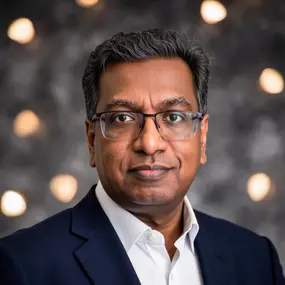
CTO and Co-Founder, MindStaq | AI and Enterprise Systems | Studying AI Since 1996
Sai Prakash is the CTO and co-founder of MindStaq, an AI-native work management platform built to unify scattered tools and give teams a system that actually knows their work.
He has spent more than 25 years in technology and product leadership, building and scaling platforms at the intersection of enterprise systems, AI, and user-centric design. He spent six years at Microsoft and held roles at Thomson Reuters and Agility.
He holds a Master of Science in Mathematics and Computer Science from Sri Sathya Sai Institute of Higher Learning, where he studied artificial intelligence in 1996, during the years the field had gone quiet. He later completed entrepreneurship study at The Wharton School.
On the show, Sai brings the long view. He was inside this technology three decades before it became fashionable, which makes him unusually useful at separating what is real from what is being sold.