

Capacity Is Not Character: How Leaders Prevent Burnout Before It Starts


We are in a burnout crisis. And the leaders who hit the wall in March are the ones who never saw it coming in January.
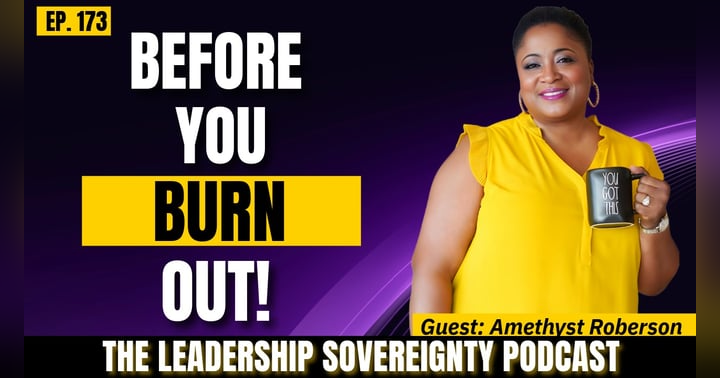
In this episode of the Leadership Sovereignty Podcast, host Ralph Owens and co-host Terry Baylor welcome Amethyst Roberson — therapist, author, and emotional intelligence strategist — in the first of a five-part conversation on self-care, burnout prevention, and what it means to lead from the inside out. This is Part 1 of 5.
Amethyst introduces her three-part framework for preventing burnout before it starts: capacity, condition, and courage. She draws a sharp distinction between capacity and character — and why most high performers burn out because they let their integrity override their awareness of what they can actually hold right now.
What you will learn in this episode:
- Why burnout is predictable — and what you can do about it before it starts
- The difference between capacity and character and why confusing them leads to breakdown
- How to assess your condition before you take on more responsibility
- The three stabilization factors every leader needs before offering solutions
- Why performance mode is the enemy of sustainable leadership
This episode is for you if:
- You start every year strong and hit a wall by Q1
- You lead others without checking in on what you personally can hold
- You have never separated your integrity from your actual capacity
- You want a practical framework for leading sustainably all year long
👤 View Amethyst Roberson's guest profile
🧾 Chapters
- (00:00) - Leaders Who Prevent Burnout Before It Begins
- (01:05) - New Year, New Mindset for Leadership Wellness
- (02:32) - The Four Tenets That Drive Whole Leadership
- (03:45) - Burnout Is Predictable — and Preventable
- (05:26) - Recognizing Early Warning Signs of Burnout
- (06:10) - The 3Cs Framework: Capacity, Condition, and Courage
- (07:16) - Stabilizing Yourself Before Leading Others
- (09:07) - Character vs. Capacity — The Leadership Disconnect
- (10:37) - Understanding Capacity in Teams and the Boardroom
- (12:24) - High Performance, Hidden Exhaustion, and Leadership Awareness
***********************************
📺 Watch This Episode on YouTube
Click here to watch the full video of this episode.
***********************************
🌐 Visit the Leadership Sovereignty Hub
Everything you need to lead with clarity, confidence, and strategy — in one place.
https://www.leadershipsovereignty.com
- Listen to or watch our full episode library
- Download free leadership frameworks, guides, and tools
- Read in-depth show notes and guest takeaways
- Submit your leadership questions or episode topic suggestions
***********************************
📩 Get Every Episode Delivered to Your Inbox
Join the Leadership Sovereignty newsletter and get new episodes, leadership insights, and exclusive resources — plus get instant access to our free AI Toolkit: the practical guide smart professionals use to think clearer, communicate better, and make smarter decisions at work.
***********************************
⭐ Help a Leader Find This Show
If this episode added value to your leadership journey, take 60 seconds to leave a rating or review. Every review puts this content in front of another professional who needs it.
🟣 Leave a Review on Apple Podcasts
🟢 Leave a Rating on Spotify
✍️ Leave a written Review
***********************************
🔁 Know Someone Who Needs to Hear This?
Share this episode with a colleague, mentor, or team member who would benefit from this conversation. Leadership grows when we invest in the people around us.
***********************************
📲 Follow the Conversation
Stay connected and join the leadership conversation on social media.
▶️ YouTube
🔗 LinkedIn
📸 Instagram
🎵 TikTok
🧵 Threads
🐦 X
📘 Facebook
***********************************
🎤 Work With Ralph & Terry
Looking for dynamic speakers for your next event or leadership summit? Ralph and Terry bring executive-level insight, real-world leadership strategy, and an engaging presence that moves audiences to action.
*Connect with us*
***********************************
💰 Support Independent Leadership Media
This show is independently produced to keep the content unfiltered and audience-first. If these conversations are helping you lead better, your support directly funds the next conversation.
★ Support this podcast ★
***********************************
📄 Full Episode Transcript
Click here to view the episode transcript.
00:00 - Leaders Who Prevent Burnout Before It Begins
01:05 - New Year, New Mindset for Leadership Wellness
02:32 - The Four Tenets That Drive Whole Leadership
03:45 - Burnout Is Predictable — and Preventable
05:26 - Recognizing Early Warning Signs of Burnout
06:10 - The 3Cs Framework: Capacity, Condition, and Courage
07:16 - Stabilizing Yourself Before Leading Others
09:07 - Character vs. Capacity — The Leadership Disconnect
10:37 - Understanding Capacity in Teams and the Boardroom
12:24 - High Performance, Hidden Exhaustion, and Leadership Awareness
Ralph Owens (00:00)
why is it important to amethyst?
for people to understand how to prevent burnout before it even starts.
Amethyst Roberson (00:04)
think personally that we are in a burnout crisis
I ask individuals that I work with to look at your capacity. What realistically can you hold right now? Capacity is not character.
Ralph Owens (00:13)
Mm.
All right, welcome to another edition of the Leadership Sovereignty Podcast. It is 2026, can you believe it? Terry, how you feeling?
Amethyst Roberson (01:05)
You
Terry Baylor (01:05)
Man, I will say new me, but I like, you know, I'm just moving it, keeping it moving forward, man. I don't know, I don't know. Some people say new year, new me. I don't know.
Ralph Owens (01:15)
Uh-huh,
yeah, yeah, yeah, I feel you, I feel you, I feel you, I feel you. But we are extremely excited to welcome our first guest of the year, Ms. Amethyst Roberson, good, good friend of mine. We go back a long time, a long, long time. I won't try to give your introduction for you. How about you introduce yourself to the people and tell them a little bit about yourself.
Amethyst Roberson (01:31)
I'm getting old here.
Terry Baylor (01:34)
haha
Amethyst Roberson (01:38)
Yeah, hi, my name is Amethyst Roberson. And like Ralph said, we go way back. And look, I think this is a meetup in God's timing. And so I'm excited about being on the show. I've been doing therapy 20 plus years in various capacities. My heart is to bring healing, empowerment, and restoration to everyone, specifically for women ages 24 to 44.
A lot of people fees from what I have to offer as well. So that's me in a nutshell. again, I'm excited and grateful for this opportunity.
Ralph Owens (02:11)
Awesome, awesome, awesome. Well, we appreciate you being here. Yes, we appreciate you being here. One of the focuses that we wanted to spend some time on this year was about self care, right? And wellness and mental health. So I know that what you have to share is gonna be really monumental to all of the listeners. Anything, Terry, you wanna point out before we jump in?
Terry Baylor (02:12)
Yes, yes, yes, yes, we're super excited.
Amethyst Roberson (02:15)
Yep.
Terry Baylor (02:32)
Look, those four tenets we talked about last year, you got to make sure that you're physicals together. You got to make sure that you're mentals together. You got to make sure your relationships are together. And you got to make sure they're spirituals together. So, man, those four tenets drive everything that we are. And I can't wait to hear Amethyst dig into that, because she's said some things, man.
Again, Ralph, you know me, I'm, look, I apply immediately. So she said something last week on our, on our touch point and I was applying it immediately. So I just, I hope everyone's just, just be attentive cause it's going to be good. Amethyst has some great, great, great, great, great information, man. So I can't wait.
Ralph Owens (03:01)
Yes.
Amethyst Roberson (03:03)
Right.
Ralph Owens (03:06)
Yeah.
Yeah.
Amethyst Roberson (03:16)
awesome.
Ralph Owens (03:18)
Yeah, I get a chance to not only help co-host this, but be the student, right? Because again, I started learning so much. I'm like, this is be juicy. I can't wait to dig in. All right, well, let's kind of kick it off. So again, we're in Q1, 2026. So many times we see leaders start the beginning of the year very, very strong. And then by March, they hit a wall. So before we even dive into all the details, why is it important to amethyst?
Terry Baylor (03:28)
Yes. Yes.
Amethyst Roberson (03:29)
Let's
go, let's go.
Ralph Owens (03:45)
for people to understand how to prevent burnout before it even starts.
Amethyst Roberson (03:49)
You know, I think the thing about that question is that it's predictable. Like, we already know that burnout is a major thing. it's kind of like how many times do we have to hit that wall before we actually get up and, like Terry said, immediately implement it, you know? And so I think the answer to that is that it's predictable. It's something that can be, there's something we can do about it. You know, ⁓ there are
Terry Baylor (03:54)
you
Ralph Owens (04:07)
Mm.
Mm.
Amethyst Roberson (04:17)
aspects of burnout and we'll probably get into that later where it's you're almost at that too late point and so I think we're just at a place in society where it's predictable we can do something about it. think personally that we are in a burnout burnout crisis and what I mean by that I read a recent study where it talked about different types of burnout in different populations
Ralph Owens (04:24)
Hmm.
Mmm.
Terry Baylor (04:36)
Hmm.
Amethyst Roberson (04:44)
they're all being affected and it 10 times. So by next year, when you have this conversation again, people will be immersed in burnout and we just have to get into this conversation and make this a part of our journey, not destination, but our journey, just like physical health. We talk a lot about working out, we talk about mindset, but we don't talk a lot about burnout and we just have to put it
Ralph Owens (04:47)
Mmm.
Mm.
Hmm. Hmm.
Mm-hmm.
Amethyst Roberson (05:13)
parallel alongside of everything else that we get excited about, that we set new year resolutions about, we need to set a resolution about burnout. What will I tolerate this year and what won't I tolerate this year? Starting off with that question that is predictable. So, yeah. Yeah.
Ralph Owens (05:20)
Mm-hmm.
Terry Baylor (05:25)
Mmm.
Ralph Owens (05:26)
Mm.
Thank you.
Okay, that's so good, so good, so good. Well, let's
just go ahead and dive into the details How do leaders prevent burnout before it starts? So from your experience, what are some of the early warning signs leaders typically miss that burnout is already taking root in their lives?
Amethyst Roberson (05:46)
my gosh, I can think of a million examples. And I have to be careful just because of confidentiality, but I have situations in my mind when you ask that question, most leaders, corporate CEOs that I have worked with, they are dealing with burnout when it's too late. And so I think the conversation around the signs and the signals
Ralph Owens (06:05)
Mm.
Amethyst Roberson (06:10)
And I talk a lot about how to focus on the data that your body gives you is important to really discover. So one way that I do that is I ask individuals that I work with to look at your capacity. What realistically can you hold right now? Capacity is not character. So character is a set of references that you have built up that
Ralph Owens (06:14)
Mm-hmm.
Mm.
Mm.
Amethyst Roberson (06:35)
that equal you, who you are. But when you have stress entering into the picture, character is not always the go-to. We have to have capacity. So if I have integrity and then I go through something difficult, or my team is falling apart, or if I'm falling apart as a leader of leaders, how do I combat that? I have to really ask myself this question. What realistically can I hold right now?
Ralph Owens (06:46)
⁓ Mm-hmm.
Mmm.
Amethyst Roberson (07:00)
The
second one is I have to come in and understand my condition. What condition am I in right now? What shape am I in? Like again, if we focus on the physical aspect of it, if you haven't worked out in three years, you don't go in pumping weight, right? It's a gradual reps. It's a gradual step up to the next weight. Why? Because you don't want to strain your muscle. You want to overcome whatever
Ralph Owens (07:04)
Mm.
Mm-hmm.
Amethyst Roberson (07:25)
muscle relaxing that you did over the last two years, you wanna overcome that, that's your condition. So it is important for leaders to look at capacity, their condition, and then the last one is their courage. The courage is being able to face whatever, no matter what is coming at you and allowing yourself not to be, I guess, focused on you being abandoned if you still do that thing. So you're a leader, a leader.
Ralph Owens (07:29)
Mm-hmm.
Mmm.
Amethyst Roberson (07:51)
If you call yourself being a leader and you have to make a call that's not as welcoming to the crew, you still have to have the courage to say and do what you need to do. And so that would be what I would say, do you gather yourself here at the beginning of the year, how do leaders really get in touch with who they are, is really a stabilization factor.
Ralph Owens (07:59)
Mm-hmm.
Mm. Mm.
Amethyst Roberson (08:16)
You have
to stabilize yourself first, then offer solutions. So that's where the internal work comes in as a leader, stabilize who you are. So through that, then you can bring the solutions to other people. So being mindful of those three things have been really helpful to me personally and helpful to leaders that I have worked with in the past.
Ralph Owens (08:19)
Mm-hmm. Mm.
Mm-hmm. Mm-hmm.
Mm-hmm.
Terry Baylor (08:39)
Sure, got a good question on that. So can we dig back into, said character is not capacity. No, so can we dig into that? Because for a person like myself, I mean, that really resonated with me, right? Because we tend to tie our performance and our follow through with the fact that I said, basically, look, I'm gonna do what I said I was gonna do, right? And that, yeah, and so when you say I'm gonna keep my word,
Ralph Owens (08:39)
powerful.
Amethyst Roberson (08:41)
Yeah.
No, yeah, yeah.
Yeah. Yeah. Yeah.
Base the pump.
Ralph Owens (09:02)
And that's a point.
Amethyst Roberson (09:02)
I'ma keep my word.
Yeah.
Terry Baylor (09:07)
I mean, that is a huge, that's a huge balancing act, right? Because I've never, I don't think I've ever disassociated character from my ability to do it, right? That's a huge call out. How do we, give me some, how do we do that? Right? I need that today, right?
Amethyst Roberson (09:23)
Yeah,
Yeah, right. We all do, So character to me deals more with how you value something, how much you value it, right? I can have, and I'm going give you this example. I can have a million dollars in the bank, right? You can have a million dollars in your bank account, right? We might not have the same value of what's in the account.
Terry Baylor (09:33)
Mmm.
Amethyst Roberson (09:48)
And when we don't, the value is the character, right? The character is the structure that I need to live every day. But if I don't have the same courage, I'm going to spend that in a different way. If I have a different capacity in life, I'm going to spend my million in a different way. If I have a different condition, I'm not going to spend it the same as you. So,
Ralph Owens (10:01)
Mm-hmm.
Mm.
Mm.
Amethyst Roberson (10:12)
That's
the difference between character. Character is the value that we hold. It's in the bank. It's the value that we hold on something. But how do we deal with that value when life hits? We all spin it down differently, right? And that's based upon our, no longer just our character, but on our capacity, our condition.
Ralph Owens (10:17)
Mm-hmm.
Mm.
Mm-hmm. Mm-hmm.
Terry Baylor (10:29)
Mm-hmm.
Amethyst Roberson (10:37)
and our courage. That may come from a poverty mindset. That may come from a person who is investing and they take more risks. That's not character. That's their capacity and condition and their courage kicking in. So that's how I differentiate character versus capacity, condition, and courage.
Ralph Owens (10:40)
Mmm.
Hmm.
Ooh.
Terry Baylor (10:52)
Mmm.
Amethyst Roberson (11:00)
We're just going to be doing things different. So take that example and put it into the boardroom and leader dispensing information that they feel is valuable has to be knowledgeable of all the capacities, conditions, and courage at the table. They're not going to dispense the same information in the same way, at the same speed, at the same time. Why?
Ralph Owens (11:05)
Okay.
Mm-hmm.
Hmm.
Amethyst Roberson (11:24)
because of their capacity. you have to give, again, that's the data that we gather from our teams so that when we do give that value to them, we know what they're gonna do with it. We know how they're not just do with it, but a thought just came, how they are going to handle what I gave them. And I think that's at the base core of every leader. How is this person gonna handle the role and responsibility?
Ralph Owens (11:36)
Mm, that's good.
Okay.
Amethyst Roberson (11:52)
than I gave them. Now, you can take that and you can make it individual, or you can take that in relationships. It still applies. How is this person going to value me and what I bring to the table? Look at their capacity, look at their condition, and look at their courage. There's markers along the way for years and years in everybody's life. So hopefully that kind of gives a good example of what I meant by that. Yeah.
Ralph Owens (11:59)
Mm.
Terry Baylor (12:19)
Yeah, it does.
It does. It does. I really appreciate you breaking that down. Thank you so much.
Amethyst Roberson (12:21)
Yeah, yeah. Thank
you. Yeah.
Ralph Owens (12:24)
That was really powerful and it hit
on so many different levels because to Terry's point, now I'm introspectively reviewing myself and how I function, right? How many times have I actually paid attention to my condition? Because to Terry's point, my integrity saying that I'm going to get this done has overridden everything else. Do I have enough capacity to do it? Am I even in a good place to get this ⁓ done?
Amethyst Roberson (12:34)
Yeah, yeah.
Mmm.
Terry Baylor (12:44)
Yes.
Amethyst Roberson (12:45)
Wow. That's good though.
Ralph Owens (12:51)
We never consider that. No. The job's got to get done, right? Yeah, yeah. Wow, wow, that's heavy, man. That's heavy. That's good.
Amethyst Roberson (12:51)
Wow. Yeah. Yeah.
Terry Baylor (12:52)
No, we don't. It's just look, the job's got to get done. That's it.
Amethyst Roberson (12:56)
Performance, somebody said performance, yeah. yeah, yeah. it's
a process, it's what we, you know, it's what we learned over time to compensate as well. But performance though, that is the key thing. Like when we get into performance mode, it's hard to think about those three aspects of our life. So it's kind of easier said than done type of situation.
Ralph Owens (13:07)
Mm-hmm.
Mm-hmm.
Right, right.
⁓
Amethyst Roberson (13:25)
But
yeah, it definitely helps stay out of that performance mode 24-7.
Ralph Owens (13:31)
You know, it too, I just want to say I appreciate that because I have a number of people who report to me and...
taking into account what their condition is and what their capacity is. Capacity, yeah, I probably have focused on that, but condition, no. It's like because, and I think it's more so because within myself, I've never allowed myself to focus on my condition as it pertains to a task that's been given to me. If they told me it had to be done, it just had to be done. Now maybe that was the military in me, right? Because they don't really care about your condition, right?
Amethyst Roberson (13:44)
Yeah. Yeah.
Yeah. at
Ralph Owens (14:02)
you better get this done, right? You know, so I've, know, in times past, I've, hey, I need you to get this done. And I'm not considering those two things. So that's really, really helpful. Thank you for that again.
Amethyst Roberson (14:04)
You better get it done. Yeah.
Yeah, absolutely.

Author | Speaker | Wellness Educator
Amethyst Roberson is an author, speaker, and wellness educator with over 25 years of experience helping individuals and communities build emotional resilience, leadership capacity, and sustainable wellbeing. Her work centers on healing, empowerment, and restoration—bridging faith, emotional intelligence, and practical life skills. Through books, music, keynote talks, and educational programs, Amethyst equips people to lead themselves well, navigate trauma, and reclaim their voice with courage and clarity.