
 Apple Podcasts
 Spotify
 YouTube
 Mentorship, Sponsorship and Leadership Pt. 3
Summary
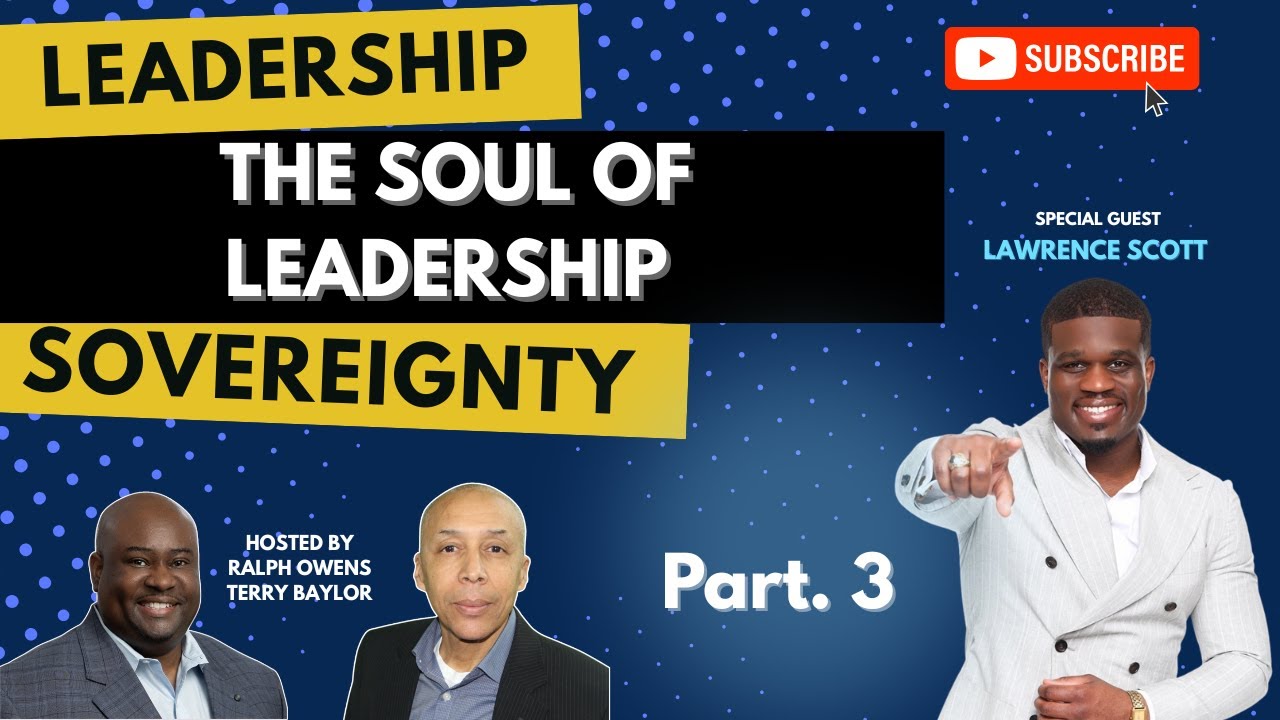
In this episode of Leadership Sovereignty, Ralph Owens and Terry engage in a deep conversation about mentorship, personal growth, and the importance of creativity. They explore the qualities that make a good mentor, the challenges of imposter syndrome, and the necessity of self-reinvention in one's career. The discussion emphasizes the value of uncomfortable conversations in mentorship and the significance of understanding one's own motivations and creative impulses.
Takeaways
- Mentorship is a relationship built on trust and honest feedback.
- A good mentor will challenge you and push you to face uncomfortable truths.
- It's important to find a mentor whose values align with yours.
- Being specific about your goals when seeking mentorship is crucial.
- Imposter syndrome can be reframed as a natural part of growth.
- Creativity is essential for personal fulfillment and growth.
- Reinvention is a key aspect of career development.
- Self-reflection helps in understanding one's motivations and challenges.
- It's okay to feel uncertain and to miss; what matters is how you respond.
- The journey of personal growth is ongoing and evolves over time.
Welcome to Leadership Sovereignty Podcast. I'm your host Ralph Owens along with Terry Baylor. In today's episode, we'll touch on topics such as the criteria of a good mentor, how uncomfortable conversations can push you into your destiny, how to ask someone to be your mentor, and questions for self reflection. Let's go. What would you say are the criteria for a good mentor if you were seeking one out, you know, based on your experience?
Speaker 2:Oh, wow. You know, it kinda reminds me of that question you get when you were younger. Hey. So what is a perfect wife for you? Well, honestly, what is a perfect wife for you?
Speaker 2:Well, you know, you you know, you you know what it is at that stage. And I throw the word no in quotes. You know what it is until you realize, no, I don't know what it is. But you know, to me, mentorship is not any, it's not any different to that really. It's just another form of relationship.
Speaker 2:It's, it's about, someone that you can actually trust to give you honest feedback. And, you know, I think, Terry, you brought it up earlier. You're right. Mentors, a good mentor will have you uncomfortable. It will have you realize that, Hey, you know what?
Speaker 2:We're going to have some uncomfortable conversations, but these are things that are probably topics that you avoided about yourself that you don't want to go over. And sometimes you need someone to kind of push that to your face to say, look,
Speaker 1:that's good
Speaker 2:to, you know, tackle it head on. That's how you actually move forward. And then, and I, I, I would honestly say, I don't know any scenario where someone is kind of made me face my own truth that it turned out negatively. Yeah, it was uncomfortable, but at the end of the day, was definitely, it was more of a, of a, of a, of a boost to my growth in, in my career. You know, it, it actually made me realize that there's some things that I was taking for granted or, or basically some, some base decision making processes that we're we're coming from really just a a bad place, just just not from a a truthful, space.
Speaker 2:So sometimes having someone push you into more of a realistic mindset helps you move forward as well.
Speaker 1:That's good. That's good. Terry, what would you add there as some criteria for a good mentor?
Speaker 3:Really somebody honestly that you see something in them that you'd wanna emulate. I mean, that's really at the core and the crux of it, right? Their core values align with your core values. If loving people is a core value for you, then you need a mentor who loves people. If technology and understanding how the technology impacts the business, right?
Speaker 3:If they are a business outcome type leader, then, hey, you know what? I'm gonna ask, right? Will you mentor me? Right? And then most importantly, at the end of the day is their character, right?
Speaker 3:There have been times where there are folks that I wouldn't necessarily consider a mentor, but there may be an attribute of something that they display, then I have to get that just from, you know, from watching, right? You know what, I'm gonna see how they do. I'm not gonna sit down with you and spend quality time, but I can see how you execute, or I can see how you facilitate this particular aspect. But again, in terms of that mentor, it's going to be something that you see in their life that you want in your life. It's as simple as that.
Speaker 3:And really as simple as asking a question, will you mentor And as we learn, be very specific about that, right? If you can hone it in, I'm looking to accomplish A, right? I'm looking to learn B, right? I am at position B in my career now, which is going great, but I'm looking to be in position D. Right?
Speaker 3:I wanna skip two levels. Don't I don't wanna spend a lot of time here at this SC. Mhmm. Right? So how do I do that?
Speaker 3:And I think those are core things, And I think, Akpura, you dug into a few things, right? One of the key components is we really have to be honest with ourselves. Who am I? Where am I? Why am I where I am today?
Speaker 3:Right? Is it a lack of information? It's great. Is it a lack of enthusiasm? Is it a lack of motivation?
Speaker 3:Right? So if we can really hone in on that to understand who we are, and I think that imposter syndrome, personally, I'm on the fence. I'm on the fence about that term. And I'll tell you why. Most great people who go into something, they all feel like, man, this may be too much.
Speaker 3:I think everyone, I mean every great leader who's done something right because the vision is so big, there are going to be moments of know, okay, how's this gonna work out? The beauty in it though is you don't stop. Is it imposter syndrome, really? No, I just got some questions about how it's gonna happen, but I'm committed to it. We're not gonna know it.
Speaker 3:Here's the thing, right? Back to Apara, right? What does the perfect wife look like?
Speaker 2:What
Speaker 3:does the perfect project look like? What does the perfect business look like? What does the perfect entrepreneurial situation look like? You think you know, but until you start going down that path, man, what I'm saying is this, right? And Ralph knows this about me.
Speaker 3:I am a challenger at the extreme level. You know, I just because you said don't mean it's true to me. I'm I'm sorry. You gotta give me some evidence. I'm I'm fact based.
Speaker 3:And, you know, so we're I'm not I'm not saying that it's not a true thing, but I think there are times we ascribe to things because it's comfortable. Right? We take on other people's ideas and ideologies about us, and we haven't dug in enough to really ask ourselves, where are you? You know, take some time, and this is an exercise that Ralph and I have talked about, take some time and write out your thoughts and then go back and read them. And then you can really see, okay, this is really what is on the inside of me, right?
Speaker 3:And so as you are really, you know, devving into who you are, understanding what your levers and switches are, what makes me feel uncomfortable? What makes me feel at my highest level? Right? And I'll be transparent. I told my wife this a few weeks ago, you know what I realized about me?
Speaker 3:If I'm not creating, I'm dying. I realized that about me. It doesn't matter what it is. If I'm writing a song, if I'm hanging shelves, if I'm out on the court with my son and we are, you know, going through something and creating a routine, most creatives, right, and what's God has made us all creatives, right, just in what area are you, if you're not creating, right, whether that's your path, a paper, an ebook, a podcast, an airplane, paper airplane. Man, start start with a paper airplane.
Speaker 3:Create that. What I'm saying is that there's such a reward when you can look back and say, I did that. God did He was like, I looked at day one and it was good. So, man, look, I'm telling you, start practicing those things. And I I and so that's that that's really what I have to say.
Speaker 3:It's okay to challenge yourself and you're gonna stretch yourself beyond your comfort zone. It's okay. And it's okay to feel some uncertainty and it's okay to miss. We're gonna miss. It's okay.
Speaker 3:What do we do with that miss? So that's that's kind of what I hear in Akbar's story. And and and we know that it's a successful story. It's still evolving. It's not over.
Speaker 3:But when I hear him talk about his journey, and definitely I want to dig into that a little bit too, right? Because I think it's important that our listeners understand that where you start is not where you end and not, you know, sometimes we have to go to new environments to get to one plateau to another, to another, to another, but it's not always the case. I mean, we have living proof right here Ralph, in one of our earlier shows, I'd shared that, Akpar, I really want to hear your take on this. Years ago, man, I was mentoring a guy and we were on the same team. I didn't know I was mentoring, but I was mentoring.
Speaker 3:He texted me something. This was probably maybe ten, eleven months ago, shortly after we created the show. And he said, Terry, you told me something. He said, You have to be willing to reinvent yourself. So I want to understand how you've been able to do that in your space, right?
Speaker 3:Because I'm sure there may be some people who've been there from the beginning, or at least there are some people who've seen you the last five. They've seen you the last ten. How have you reinvented yourself as you've stepped through these different spaces? Right? Because at the end of the day, you're not the guy that came in the door as the intern.
Speaker 3:Right?
Speaker 1:You're the guy. Thank you for listening to the Leadership Sovereignty Podcast. We hope that you not only enjoy the content, but gain something to help you on your leadership journey. Feel free to reach out to us on X, Instagram, and LinkedIn under the handles Leadership Sovereignty. And until next time, safe, peace, and blessings.