
 Apple Podcasts
 Spotify
 YouTube
 Technology Is Far More Aligned With the Business Than People Think: How to Earn Your Seat at the Table (Part 2 of 7)
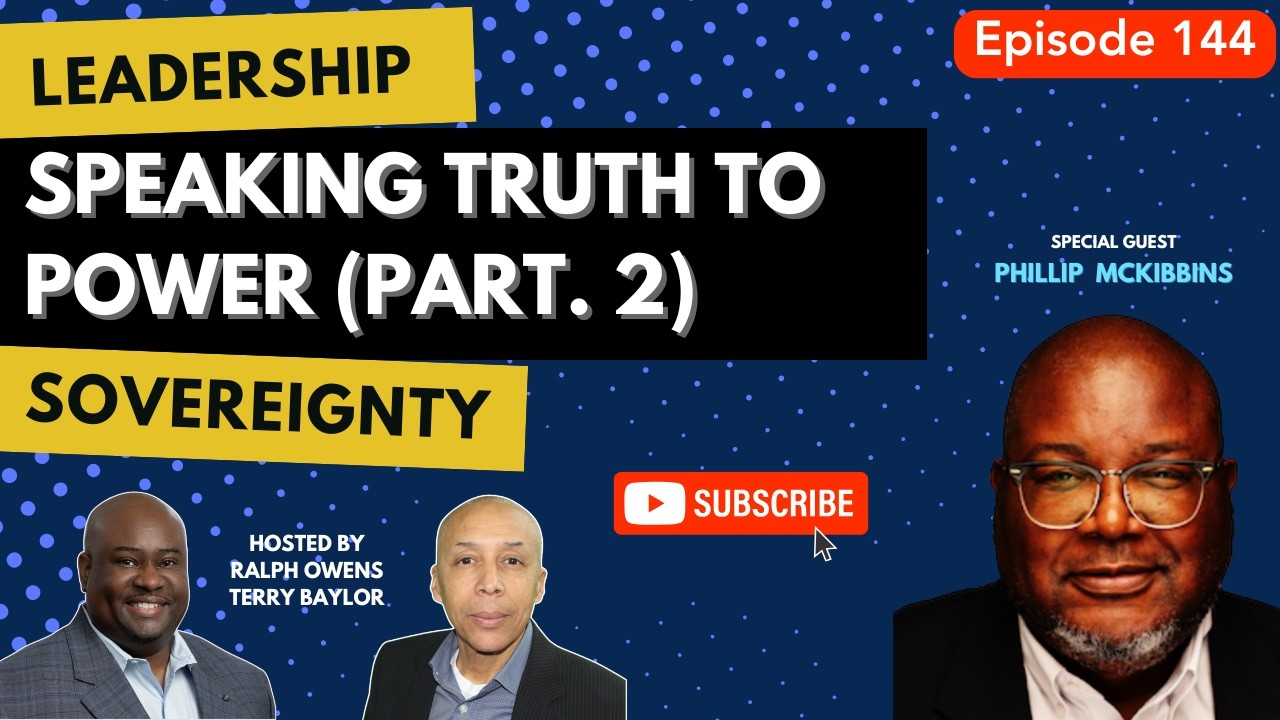
Most people think technology is there to keep the lights on. Phillip McKibbins spent 30 years proving them wrong.
In Part 2 of 7 of the Leadership Sovereignty Podcast's Speaking Truth to Power series, Phillip opens with the principle that defined his career: technology is not a support function — it is a revenue driver. He shares how his mentor at ESPN, CTO Aaron LaBerge, called him "the technology whisperer" for his rare ability to translate technology into business language. And he reveals how a failed Google interview sent him to the University of Texas for cloud training — which eventually led to the Dodgers, and then the Mavericks.
He also shares the career principle that changed everything: when you align with the business and learn how money is made, you stop being overhead and start being indispensable.
In Part 3 you will hear how the most important leadership lessons Phillip ever learned came not from a classroom — but from learning to follow first.
What you will learn in this episode:
- Why technology professionals who understand how the business makes money will always advance faster
- How a failed Google interview became the turning point that led to the Dallas Mavericks
- What Aaron LaBerge saw in Phillip that most executives miss in their own teams
- How to position yourself as a revenue driver — not a cost center
- Why earning a seat at the C-suite table starts with serving the business before asking for authority
This episode is for you if:
- You are in technology and want to move from manager or director to VP or C-suite
- You want to understand how to speak business language without losing your technical credibility
- You are ready to stop waiting to be discovered and start aligning with the people who make decisions
- You want to hear what 30 years of C-suite navigation actually looks like
***********************************
👤 View Phillip McKibbins' guest profile, resources, and contact information
***********************************
Chapters
00:00 The Evolution of Becoming a Leader
02:04 The Importance of Sponsorship and Technology in Business
12:44 Aligning Technology with Business Goals
***********************************
📺 Watch This Episode on YouTube
Click here to watch the full video of this episode.
***********************************
🌐 Visit the Leadership Sovereignty Hub
Everything you need to lead with clarity, confidence, and strategy — in one place.
https://www.leadershipsovereignty.com
- Listen to or watch our full episode library
- Download free leadership frameworks, guides, and tools
- Read in-depth show notes and guest takeaways
- Submit your leadership questions or episode topic suggestions
***********************************
📩 Get Every Episode Delivered to Your Inbox
Join the Leadership Sovereignty newsletter and get new episodes, leadership insights, and exclusive resources — plus get instant access to our free AI Toolkit: the practical guide smart professionals use to think clearer, communicate better, and make smarter decisions at work.
***********************************
⭐ Help a Leader Find This Show
If this episode added value to your leadership journey, take 60 seconds to leave a rating or review. Every review puts this content in front of another professional who needs it.
🟣 Leave a Review on Apple Podcasts
🟢 Leave a Rating on Spotify
✍️ Leave a written Review
***********************************
🔁 Know Someone Who Needs to Hear This?
Share this episode with a colleague, mentor, or team member who would benefit from this conversation. Leadership grows when we invest in the people around us.
***********************************
📲 Follow the Conversation
Stay connected and join the leadership conversation on social media.
▶️ YouTube
🔗 LinkedIn
📸 Instagram
🎵 TikTok
🧵 Threads
🐦 X
📘 Facebook
***********************************
🎤 Work With Ralph & Terry
Looking for dynamic speakers for your next event or leadership summit? Ralph and Terry bring executive-level insight, real-world leadership strategy, and an engaging presence that moves audiences to action.
*Connect with us*
***********************************
💰 Support Independent Leadership Media
This show is independently produced to keep the content unfiltered and audience-first. If these conversations are helping you lead better, your support directly funds the next conversation.
★ Support this podcast ★
***********************************
📄 Full Episode Transcript
Click here to view the episode transcript.
Phillip Gregory McKibbins (00:00)
Technology is far more aligned with the business than what people think. ⁓
Ralph Owens (00:04)
Mm-hmm.
Phillip Gregory McKibbins (00:06)
cases, you can't do the things you want to do without technology. They make assumptions that, it's just there and it's just supposed to work and you just keep the lights on. But it's more than that. You have an opportunity really to be able to help drive the bottom line of the company, to drive revenue and revenue creation and production.
Ralph Owens (00:10)
Right.
Yep.
Phillip Gregory McKibbins (00:59)
And, you know, several months ago, ⁓ right when I had joined the Mavs, ⁓ I saw Aaron at the NBA Technology Summit at the All-Star Game in Indianapolis. And all I could do was just...
Just thank him. ⁓ I had no idea that all those years ago, he was putting me on the path to one day sit in his chair. So it's been a great ride.
Ralph Owens (01:16)
Mm.
Terry Baylor (01:24)
Sure, sure. No,
Ralph Owens (01:24)
That's fantastic.
Terry Baylor (01:26)
that's fantastic. you know, just to speak a little bit on that, right? How important, you know, just to share it, how important was that sponsorship? Because that's essentially what it was, right? You provided a ton of value, right? And then, you know, you said a couple of things here that I took some notes on that ESPN was a technology company, right? So these, you know,
Phillip Gregory McKibbins (01:36)
my god.
Yeah.
Terry Baylor (01:52)
sure, there are business owners out there who may not understand that they may be providing a ⁓ service, but if technology is a major cog in what you're delivering, how would you encourage someone even to help that business owner understand that even? So that's kind of a two-part question. The sponsorship aspect of what you said,
And then also understanding that how does a technologist help a business understand what they are in reality? how do you know, just kind of two-part question.
Phillip Gregory McKibbins (02:32)
Well, first off, let's tackle the sponsorship piece. ⁓ None of us get to where we're going by ourselves. There are always people in our path that help and are part of the journey. ⁓ And Aaron and many of those leaders were really helpful in helping me on my journey. And ⁓ look, it was an honor to be chosen.
Ralph Owens (02:40)
Bye.
Phillip Gregory McKibbins (03:00)
It was an honor to be able to thrive. It was an honor to grow, to fail, to learn. Having a leader that was willing to allow me to grow and make mistakes and then to fix them really taught me even greater ⁓ patience and empathy on dealing with people. And then I think the biggest thing is a lot of people don't understand that
Ralph Owens (03:06)
Hmm.
Terry Baylor (03:07)
Mmm.
Phillip Gregory McKibbins (03:29)
Technology is far more aligned with the business than what people think. ⁓
Ralph Owens (03:33)
Mm-hmm.
Phillip Gregory McKibbins (03:36)
cases, you can't do the things you want to do without technology. They make assumptions that, it's just there and it's just supposed to work and you just keep the lights on. But it's more than that. You have an opportunity really to be able to help drive the bottom line of the company, to drive revenue and revenue creation and production. And Aaron had the vision of taking technology and getting it
Ralph Owens (03:40)
Right.
Yep.
Phillip Gregory McKibbins (04:05)
greater align with the business ⁓ so that we could do things like build DC2, which at the time was the most technologically advanced studio built at that time, or create ⁓ new graphics packages and new ways to ⁓ shoot a game and new ways to show ⁓ analytics and new ways to present the story.
So when you're watching ESPN and you see them on a touch screen, all that is development work. You know, it starts with someone having a vision and then believing that they can make it so and working to create it. I was around a number of some of most talented people I've ever met ⁓ that created new, innovative things that have changed the way we consume.
Ralph Owens (04:41)
Mm.
Phillip Gregory McKibbins (05:02)
information, the way we watch a game, the way we look at data, all very important. So being sponsored, having someone that believes in you is very important. But I'm going to tell you, the most important thing is believing in yourself. Because if you don't believe in yourself, and if you're not willing to take risks, and you're not willing to speak ⁓ truth to people and speak truth to power, and if you're not willing to
Ralph Owens (05:05)
Mm.
Mm.
Terry Baylor (05:19)
Mmm.
Phillip Gregory McKibbins (05:31)
⁓ put yourself on the line to grow. If you're not willing to, ⁓ assess your skills and go, you know what? I need to get better. So I'm going to go take this course. I'm going to go learn a new skill. ⁓ a years ago, ⁓ I was up for a position with Google and I had gotten all the way to the final interview and you're interviewing all day long.
Ralph Owens (05:39)
Yeah.
Mm-hmm.
Phillip Gregory McKibbins (05:58)
And they give you a problem that you have to solve. And I saw the problem was doing well. And it was with their cloud group and I was going to be a technical account manager. And the guy asked me a question about when you're doing a lift and shift, you know, ⁓ how do you deal with the data and what are you concerned about? For whatever reason, I just drew a blank. I had been interviewing for nine hours. I was tired. I didn't.
Ralph Owens (06:25)
Mmm.
Phillip Gregory McKibbins (06:28)
⁓ prep myself enough to take enough peppermint and to keep hydrating so I could keep thinking. And I could not answer the question for, you know, and soon as the call ended, I was able to go, well, of course the data is going to grow and you've got to think about what you're, dealing with. and I remember not getting that job and I was so frustrated. And I said to myself, you know what? ⁓ you need to go take.
a class in cloud computing and you need to learn the three predominant cloud platforms ⁓ because you're going to be leading people someday, you know, in this endeavor. And I ended up signing up for a class that the University of Texas had. ⁓ And man, that changed the trajectory of my career because ⁓ since then I've been able to take on more jobs and more opportunities.
Ralph Owens (07:05)
Mm.
Mm. That's good.
Phillip Gregory McKibbins (07:28)
⁓ of being able to help businesses and companies re-platform. Because back in the day, we used to live in the client server environment. And you guys know the drama you had to deal with, with building out your different servers and platforms. And now with the cloud, you really are dealing with a dynamic environment where you can expand and contract.
Ralph Owens (07:34)
Mm. Mm.
Mm-hmm.
Hell yeah.
Phillip Gregory McKibbins (07:57)
⁓ and expand horizontally and vertically based on what you need and what the needs of the business are. ⁓ And learning that has really helped catapult me and that actually helped me to get the position with the Dodgers because with their organization, ⁓ they had a very young ⁓ upstart company that was going to be focused on youth sports.
and they needed someone to be their head of technology. And I had to build that technology group from the ground up. So there was nothing. And so you become your own help desk. You become your own shop of building out laptops. You become the cloud
Ralph Owens (08:34)
Mm. Mm. Mm.
Mm-hmm.
Mm-hmm.
Phillip Gregory McKibbins (09:30)
And so you have to learn all these things. And since then,
Ralph Owens (09:30)
Mm-hmm. Mm-hmm.
Phillip Gregory McKibbins (09:36)
You know, I've always been one of these people that I thirst for knowledge. So after doing that, I felt that, you know what, you need to become a better chief technology officer. You need to learn how to take problems ⁓ and turn them into solutions for the business. So I ended up signing up at the University of Pennsylvania and went to the Wharton School.
Ralph Owens (09:55)
Right.
Mm-hmm.
Phillip Gregory McKibbins (10:05)
and
went through their chief technology officer program and ended up getting an executive MBA in their chief technology program. And it really opened my mind and my eyes to the things you have to deal with as a company and dealing with not only your internal stakeholders, but your external stakeholders and creating those opportunities where you drive more revenue.
Ralph Owens (10:08)
Mm-hmm.
Mm.
Phillip Gregory McKibbins (10:33)
Most people look at IT as being a call center. ⁓ And unfortunately, we as technologists have not done a good job in helping people to understand that we're involved in every aspect of your business. We're more than just keeping the lights on. So once we learn to align with the business and learn to apply technology to help us create those revenue opportunities, we become a lot more valuable.
Ralph Owens (10:33)
Mm.
Phillip Gregory McKibbins (11:02)
we get a seat at the table and we can help really determine the trajectory of the companies that we work for. So I encourage any and everyone out there that is in technology, do not shy away from the business. Really get to know your business leaders, become a servant leader and be there to serve. Humble yourself and be willing to go whatever it takes to help you succeed. I'm gonna do. I have this skill.
Ralph Owens (11:18)
Yes.
Mm-hmm. Mm-hmm.
Phillip Gregory McKibbins (11:32)
I'm going to apply this skill to help you be better. And that's really what I'm trying to do here at the Dallas Mavericks is be.
Better line with our fans, better line with our customers, better line with our players and our coaches, and to be able to create those opportunities that help us all win. The day I became the CTO, I became a Dallas Maverick. So I bleed blue now and I love the Mavericks. And I can trace myself all the way to sitting on the bench. I'm that connected.
Ralph Owens (11:48)
Mm.
Nice.
Terry Baylor (12:02)
Awesome.
Ralph Owens (12:09)
Hmm.
Hmm.
Phillip Gregory McKibbins (12:12)
with
the Dallas Mavericks. So I hope I answered your question.
Ralph Owens (12:16)
Yeah, I, man, I got so much. just want to dig out of that, man. So ⁓ you definitely speak in my language, right? And I, I'm fortunate to have a role as a CIO in financial services. And a lot of the things that you said resonate with me specifically, because these are the things that I was told were the reasons why I was selected to do what I do, right? Your understanding of the business, number one. So it,
Terry Baylor (12:16)
Sure.
Phillip Gregory McKibbins (12:24)
Mm.
you
Ralph Owens (12:44)
In this particular scenario with the three of us, we all IT guys, right? You know, that's not always the case when we do shows. So you know what we're talking about where as a, as a technologist, you can get so entrenched in your own technology that you are oblivious to how the business makes money. Right. And when you take the time to shift your focus to, I need to understand how this company makes money. And I love the way you articulated that. Right. I understand how the business makes money.
Phillip Gregory McKibbins (12:48)
Yeah.
Ralph Owens (13:14)
And now I can take what I, what it is that I know and apply it to that and help them with their cause. Right. All for all of our friends and family out there who are in technology, who want to get from that manager, director, senior manager to VP and to a CTO or CIO. That is what it takes. That is the big shift. mean, like when did that shift occur for you where you focus not so much on being obsessed with just the technology itself.
because you love technology, but there's a business purpose here that I need to understand so I can tie the two together. Can you talk on that just a little bit more?
Phillip Gregory McKibbins (13:53)
Well, I'm really fortunate because I've had a number of people in my career that have helped me. ⁓ you know, I even used to work for IBM many, many, many, many, many years ago. And ⁓ I had a a woman by the name of Mary Harris, that taught me how to conduct.
a joint application development session, also known as a jazz session. People now think of it as a white paper session or a brown paper session, or they'll even now, some of the younger people will call it a sticky note session. ⁓ But I was taught how to take a concept from a very general concept ⁓ and learn how to ask key fundamental questions.
Ralph Owens (14:30)
He
Phillip Gregory McKibbins (14:43)
to drill down into the specifics. And I've learned that what you want to do is do this facilitated session where you take the people on a journey. Where...
You pose a ⁓ scenario, ⁓ a general question, and then you start working and working and working and you iterate with the people and you really get their thoughts and opinions. And once I learned this skill, I started applying it with the business. ⁓ And that really became the cornerstone for me to serve as a servant leader.
and to focus more on the business as opposed to technology. The technology is going to take care of itself. To me, I mean no disrespect when I say this, ⁓ the technology is a diamond dozen. Anybody can go purchase, but the people who can take it, apply it, and make it into something bigger and better, that's ⁓ both art and science. And once I learned that I needed to be aligned with people,
Ralph Owens (15:45)
Mmm.
Phillip Gregory McKibbins (15:50)
to solve problems, to serve them, to help them succeed, to help us generate more revenue is taking my career to new heights. And I'll tell anybody out there listening, what motivates me right now is when I come in here every day at the Mavericks, I'm thinking about succession planning. I'm thinking about who is gonna be the next CTO of the Dallas Mavericks.
Ralph Owens (16:18)
Mm.
Phillip Gregory McKibbins (16:18)
And when
I'm speaking to people in the community, and I've said this at several functions, I'm looking for the next CTO. I want, and I believe that there's a young person out there that has the drive, the ability ⁓ to someday get here. And it's going to take being willing to take on projects that other people won't do. It means coming in to work early. It means staying late.
Ralph Owens (16:27)
Yeah.
Yep.
Phillip Gregory McKibbins (16:47)
It means talking with

Chief Technology Officer for the Dallas Mavericks
As the Chief Technology Officer for the Dallas Mavericks, Phillip leads the strategic direction and execution of the technology vision, delivering innovative and engaging content across multiple platforms. He has over 30 years of experience in the industry, spanning enterprise architecture, IT infrastructure management, process consulting, technical leadership, and strategic consulting.
He holds an MS in Entertainment Business, an Executive Certificate in the Chief Technology Program from the Wharton School of Business, an Executive Certificate from the PGP program at the McCombs School of Business, a PMP certification, and a CSM certification. These credentials reflect his commitment to continuous learning and excellence in the field of technology. His mission is to create value for the Dallas Mavericks, NBA, and its stakeholders, and to foster a culture of innovation, collaboration, and excellence within the technology organization.