

 Apple Podcasts
 Spotify
 YouTube
 The Soul of Leadership Part. 2
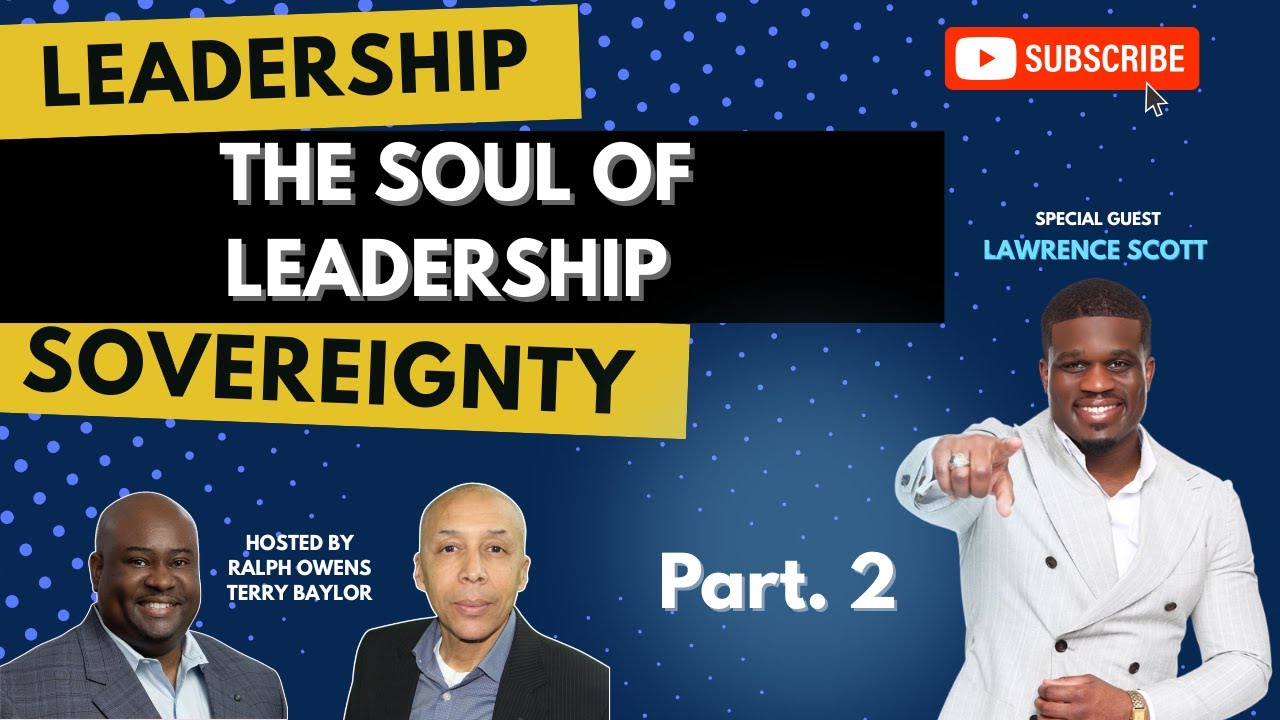
In this conversation, Ralph Owens and Terry Baylor engage with Lawrence "LoSco" Scott, who shares his personal experiences navigating academic challenges at West Point. He discusses the impact of a dismissive professor on his confidence and writing abilities, and how a supportive mentor later helped restore his belief in himself. The conversation highlights themes of identity, mentorship, and the importance of supportive relationships in overcoming obstacles.
Takeaways
- The importance of mentorship in academic success.
- Experiences of racial dynamics in predominantly white institutions.
- The impact of a professor's dismissive attitude on a student's confidence.
- The significance of supportive feedback in restoring self-belief.
- Navigating academic challenges can shape one's identity.
- Personal experiences can reveal systemic issues in education.
- The role of communication skills in academic performance.
- Resilience in the face of adversity is crucial.
- Confidence can be built through positive reinforcement.
- Understanding one's identity is essential for personal growth.
Speaker 1:
So sometimes, like, and I know you mentioned wanting to have a conversation about identity, but I think sometimes because people don't have the strength of their own identity, they'll try to diminish people who do. And they'll use their words, they'll use their action, they'll use their influence and power to try to diminish your sense of identity and confidence. And, it almost worked. Mhmm. For for me, it almost worked until
Speaker 2:
Welcome to Leadership Sovereignty, the podcast. In this conversation with Lawrence Scott, he shares his experience at West Point, highlighting the challenges he faced in an area he previously had great success. Exploring themes of identity, resilience and the power of supportive relationships in overcoming adversity.
Speaker 1:
He did not acknowledge me. He did not speak to me. Whenever I would, we had rules my freshman year. Well, all years that I was there at the football team, had rules about the way that we had to engage. We had to sit in the front.
Speaker 1:
We had to speak up in class because they would ask our teachers, how are we performing? So I had rules of engagement that I had to speak in class. It wasn't that I could just hide. So even when I would speak up in class, it was almost as if it pained him to even hear my voice in the classroom. Wow.
Speaker 1:
One of my teammates was in that classroom with me and he'll tell you, was rough. So every paper I would write in his class, I would also get pretty poor grades. And I didn't understand that because as I mentioned before, I'm not only what did I have a high GPA, but I especially excelled in areas of writing and in all areas of communication, to be honest with you. So I didn't understand that. And I kept trying to get answers from him, but again, he was very dismissive of me and did not give those to me.
Speaker 1:
That's something at West Point called additional instruction where you could schedule time to go in with the professor, sit down and then learn what you need to learn to perform better. I would schedule additional instruction with him. He would not show up during our scheduled times. Wow. When I noticed he wouldn't show up for our scheduled times, I knew that the relationship was a little contentious.
Speaker 1:
So rather than confronting him about not showing up, I would have to find different ways to try to communicate with him. So I kind of cornered him after one of our class classes and just to ask him about the grade that I got on this paper that had no notes to tell me what happened. And all he was able to say to me in that moment or all he was willing to say to me in that moment was it just wasn't what I was looking for.
Speaker 2:
Wow.
Speaker 1:
So I knew that I was dealing with something else. And it's also important to know that the population of cadets at West Point is predominantly white at the time, probably about between 15 to 18% African American, 20% minority, 15 to 18% black. So not very many of us in the grand scheme of things In terms of the population there. So the natural thing is, hey, this professor is a white man from Texas, old school guy. He probably doesn't appreciate my presence at the academy.
Speaker 1:
And he hadn't even been a professor at the academy long, to be honest with you. So I knew that I was dealing with something else. And by the time we got to our finals, we had to write two essays in a three hour block. And, I did the best work. I did the best work I'd ever done in my life.
Speaker 1:
I did the best
Speaker 2:
I laid it down today.
Speaker 1:
I did the best work I had ever to that point, I did the best work I had ever done in my life. And, you don't get your grades right away. So fast forward, to when our grades came back and I recognized in the course, I don't, I don't see my final grade yet. The grade I got on the final, but I see all of my grades for that semester. Right.
Speaker 1:
You get your final grade and then you go back and try to find the grade on the final. Right? And I recognized that I had a D in freshman English.
Speaker 2:
Wow. And I said,
Speaker 1:
what now, now going into the final, I had a C or a C minus, which meant that in order to get that final grade, I would have had to either get a really low d or an f on my on my final. Mhmm. And I was livid, gentlemen. I I I tried to go track him down. I was I said, there is no way on god's green earth.
Speaker 2:
Right. Right.
Speaker 1:
This has happened and I tried to find him. I emailed him. He would not respond to me. I tried to call the office. I could not get an answer.
Speaker 1:
I went to sit in the office to find him. He was not there. But when I showed up, I showed up carrying my final and the final grade that I got on it. Mhmm. He was not there, but the course director was.
Speaker 2:
Mhmm.
Speaker 1:
The course director tells me, hey, I can't do very much about this. He's not here to defend himself. To be honest with you, we've had other complaints, but I can't go into that. Wow. What I can do is offer you the opportunity to retake the course.
Speaker 1:
I did, learned that that professor was no longer at the academy. So they did the right thing. But my confidence in this area of communication and writing had been crushed because I have this man who's responsible for helping me to get even better at one of the best and most prestigious places in the country. And he's telling me I can't write. It's not what I'm looking for.
Speaker 1:
And then his dismissive nature made me feel as though I'm just not smart enough to get it. Because I'm trying. I'm trying to understand. Like, if I'm getting a bad grade, like, I don't know if I'd ever dealt with any particular prejudice, I didn't necessarily know it. So I'm going into it with a belief that he's actually here to help me.
Speaker 2:
Right. That's a great point though there, Lawrence, right? Because and I don't on this, we don't really delve in those there's some gray areas there where that attitude, I'll say, can present itself in a multiplicity of ways. We don't know.
Speaker 1:
And
Speaker 2:
I think that's a great point to just call out. Right? To to have the sensitivity and understanding to parse it, right, the appropriate way. Because some it could've just been a personality thing. Right?
Speaker 2:
Mhmm. It could've sometimes people just don't get along sometimes.
Speaker 1:
Right.
Speaker 2:
But why is that?
Speaker 1:
And if
Speaker 2:
I'm get if I get along with, like, 99.9, you know Yeah. Presented to people
Speaker 1:
Right.
Speaker 2:
And you're the only person that's having a problem with me Mhmm. And it's seemingly nothing to do with how I interact with you, then what is it?
Speaker 1:
Then what is it? And and the inability to get an answer. Yeah. Right? It's it's it's you have these questions in your mind, but it wasn't like I was in a position where I couldn't ask the question.
Speaker 1:
Mhmm. But I can't get an answer. Yeah. So it it leaves and then and then it left me thinking, well, maybe I am getting an answer, but I'm not understanding it. Maybe I'm not.
Speaker 1:
It's like, now I'm questioning everything. Do I even belong here? Am I like, you know? Now mind you, right? Coming out of my high school, I was I was not a guy.
Speaker 1:
I was the guy. You know what I mean? Like, like, GPA was like, wasn't like the valedictorian or salutatorian, but, like, I was up there with them. You know? I was we were in the same classes.
Speaker 1:
I was and not only that, but I was the best athlete, like, on know what I'm saying? So,
Speaker 2:
like Right.
Speaker 1:
All of these areas, all I know is excellence. That's all. That's it. Right. And then I'm in this classroom and I'm pursuing excellence.
Speaker 1:
Mhmm. And the person who's responsible for helping me to attain excellence is only like just pushing me down without giving me anything to help me climb back up. And so in a sense, you know, I was pretty crushed in that area. And what was even more crushing was the class that I had to retake because you don't retake the same class. What they do is they put you in a remedial class.
Speaker 2:
Mhmm. Mhmm. You in the class where all of those guys over there? Yeah.
Speaker 1:
You know? You know why they're
Speaker 2:
here. Right.
Speaker 1:
Yeah. I was I was in the class, man. It was only me and a few other people. We we're in there talking about periods and commas. We in I mean, you wanna talk at I'm at West Point.
Speaker 2:
Wow.
Speaker 1:
Right? The United States Military Academy at West Point, and we talking about punctuation.
Speaker 2:
We
Speaker 1:
talking about now now granted. Right? I appreciated the class. Right? I mean, I I got an a in it.
Speaker 1:
You know what I mean? Like but, and it helped to re replace the grade that I had on my my grade point average to help increase my rank in the in the class as well, which was which much appreciated. But you have to imagine someone who's excelled in all of these areas, particularly areas of communication and writing and recitation. Like I was doing poetry. I had won awards for writing and all that kind of stuff in high school.
Speaker 1:
So now I'm at the United States Military Academy at West Point, having to go into a room with people and talk about capitalization. And it's like, it's like, man, am I really this remedial? Mhmm. You know? Like, all of all of these thoughts are flowing in my head about, like, my my competence in this area.
Speaker 1:
Wow. And this the find the the next year, I was in my philosophy course. Everybody has to take freshman English. Everybody has to take philosophy especially at West Point. They want to teach you just war theory and how leaders have to make complex situations.
Speaker 1:
So, you learn from all of these philosophical lenses and whatnot. So, everybody has to take philosophy and the, the philosophy and structure structure that I had set everyone in that room down who had trouble in English, like a certain grade or lower. The previous year. And he said, this is a heavy writing course. You will have to write a lot.
Speaker 1:
If you have trouble, come and find me and we can help you. Right? Mhmm. So it's very kind of him to do. Well, midway through the course, he comes up to me and he kind of pulls me to the side, like, right before class has started.
Speaker 1:
And he said, hey, we gotta we gotta talk. Why did you fail freshman English? Now, mind you, I didn't fail freshman English. I got the D, but you put it in as incomplete. Right?
Speaker 1:
So he's like, why did you fail freshman English? Like, essentially it's failing. I see he's like, why, why did, what happened? I need to know what happened. And I I said, well, sir, I dealt with a particular professor who you know, I can't say much about what all of his motivations were but he didn't appreciate my presence in his classroom and my grades reflected that.
Speaker 1:
And he said, okay, say no more. I don't know. Maybe he already knew the story. I don't know. But he just said, okay, I got it.
Speaker 1:
You don't have to say anything else. And he said, it was so great. And I don't even know what prompted him to say this. Because he didn't have to say this. Mhmm.
Speaker 1:
But he said, never let anybody tell you that you can't write because I'm reading these papers, and these are some of the best papers I've ever read.
Speaker 2:
Mhmm.
Speaker 1:
Wow. Now, I don't know if I went in that class with something to prove because he sat us all down and said, listen, if you have trouble, I don't know. I mean, but again, I really did enjoy writing. I enjoyed communication. I enjoyed the articulation of ideas and the ability to do that, particularly in a philosophy course where I'm writing about people that I'd already gotten introduced to in high school, like Emmanuel Kahn.
Speaker 1:
It's like, man, this is amazing. I love writing. So I'm exercising this gift, this skill, and I'm doing it, but I'm also doing it with this backdrop in my head and in my heart that Mhmm. Maybe I'm not good at this. Mhmm.
Speaker 1:
So him saying that to me Mhmm. Helped to restore a confidence that another man broke. Like, he he, through his words Yeah. Broke a confidence.
Speaker 2:
Mhmm.
Speaker 1:
And then another man, through his words Mhmm. Helped to restore confidence. Mhmm. So sometimes, like and and I know you you mentioned one to have a conversation about identity, but I think sometimes because people don't have the strength of their own identity, they'll try to diminish people who do. Yeah.
Speaker 1:
Who And they'll and they'll use their words, they'll use their action, they'll use their influence and power to try to diminish your sense of identity and confidence. And, it almost worked. Me, it almost worked until, I sat now mind you, he's telling me these are some of the best papers that he's ever read.
Speaker 2:
But
Speaker 1:
wouldn't you know, after he said that to me, my papers got even better.
Speaker 2:
Wow.
Speaker 1:
Because I'm still writing with this internal, like, thing in the back of my mind, like, maybe I'm still not good at this.
Speaker 2:
Right. Mhmm. Right.
Speaker 1:
But now that my confidence has been restored, I go to a whole new level. Yeah.
Speaker 2:
Thank you for joining Leadership Sovereignty, the podcast. We hope you obtain something of value as you walk out your journey. Connect and grow with the community of LS pioneers on X, Instagram, and LinkedIn under the handle Leadership Sovereignty. Thank you and God bless.