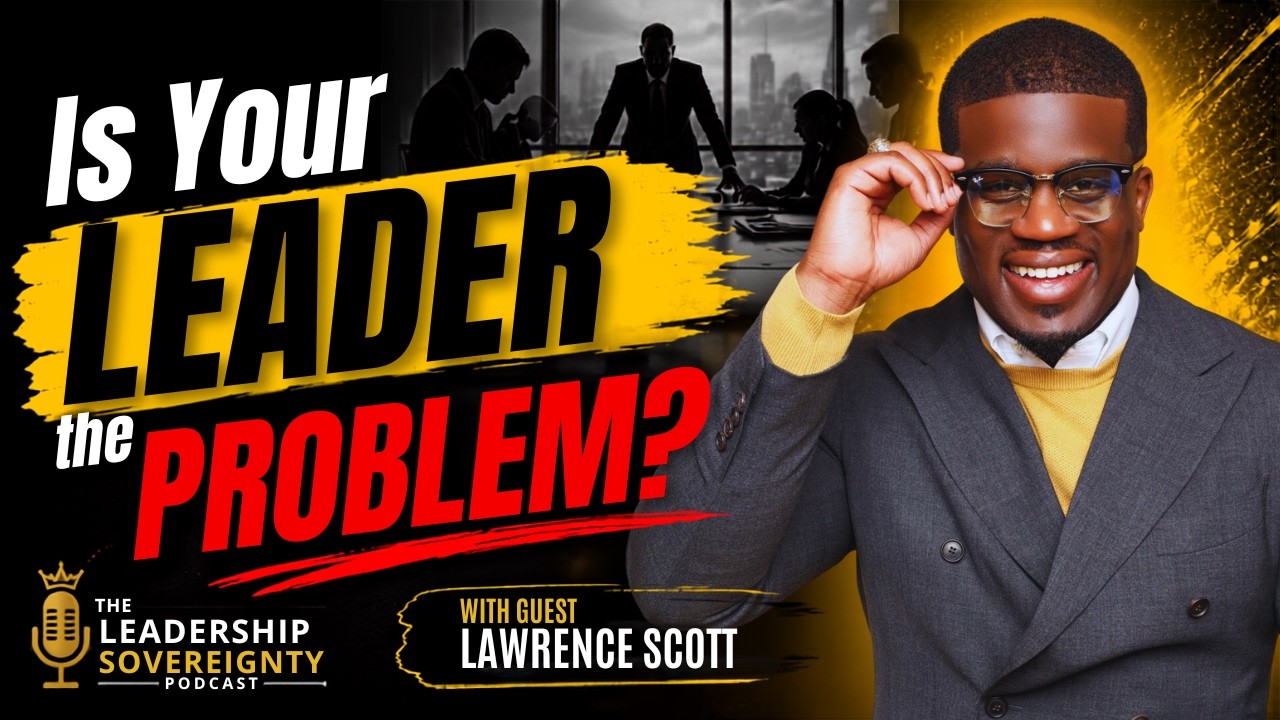
Protecting Your Professional Confidence When Your Manager Undermines Your Work

What do you do when the person responsible for developing you is the one holding you back? On Episode 186 of The Leadership Sovereignty Podcast, host Ralph E. Owens II and co-host Terry Baylor sit down with Lawrence Scott — graduate of the United States Military Academy at West Point, former Army officer, Princeton Theological Seminary alumnus, and founder of The LoSco Group — to unpack one of the most defining leadership experiences of his career. What Lawrence shares is not just a story — it is a framework every corporate professional can use to protect their confidence when authority works against them.
How to Recognize When Your Manager Is the Problem — Not Your Performance
There is a specific kind of professional damage that happens when a high performer runs into a leader who has no intention of developing them. Lawrence Scott experienced this firsthand at the United States Military Academy at West Point. A professor responsible for teaching him — a student who arrived with a 4.2 GPA and award-winning writing credentials — spent an entire semester providing no feedback, missing scheduled office hours, and returning grades that contradicted the quality of the work submitted.
The danger in these situations is that high achievers almost always blame themselves first. When someone in institutional authority tells you — through their silence, their grades, or their dismissiveness — that you are not good enough, the instinct is to internalize it. You stop trusting your own judgment. You begin to question skills you have demonstrated your entire career.
Here is how to tell the difference: a leader with high standards gives you hard feedback and a path forward. A leader who is working against you gives you criticism with no specificity, no support, and no willingness to invest in your improvement. If your manager consistently avoids giving you actionable guidance, the problem is not your output — it is their leadership.
7 Strategies to Protect Your Professional Confidence
When a manager repeatedly undermines your work, the greatest risk is not one poor evaluation or one difficult interaction. The greater risk is allowing that leader’s behavior to reshape how you see your own ability.
Use the framework below to separate your manager’s conduct from your professional worth, protect your confidence, and continue building your career from a position of strength.
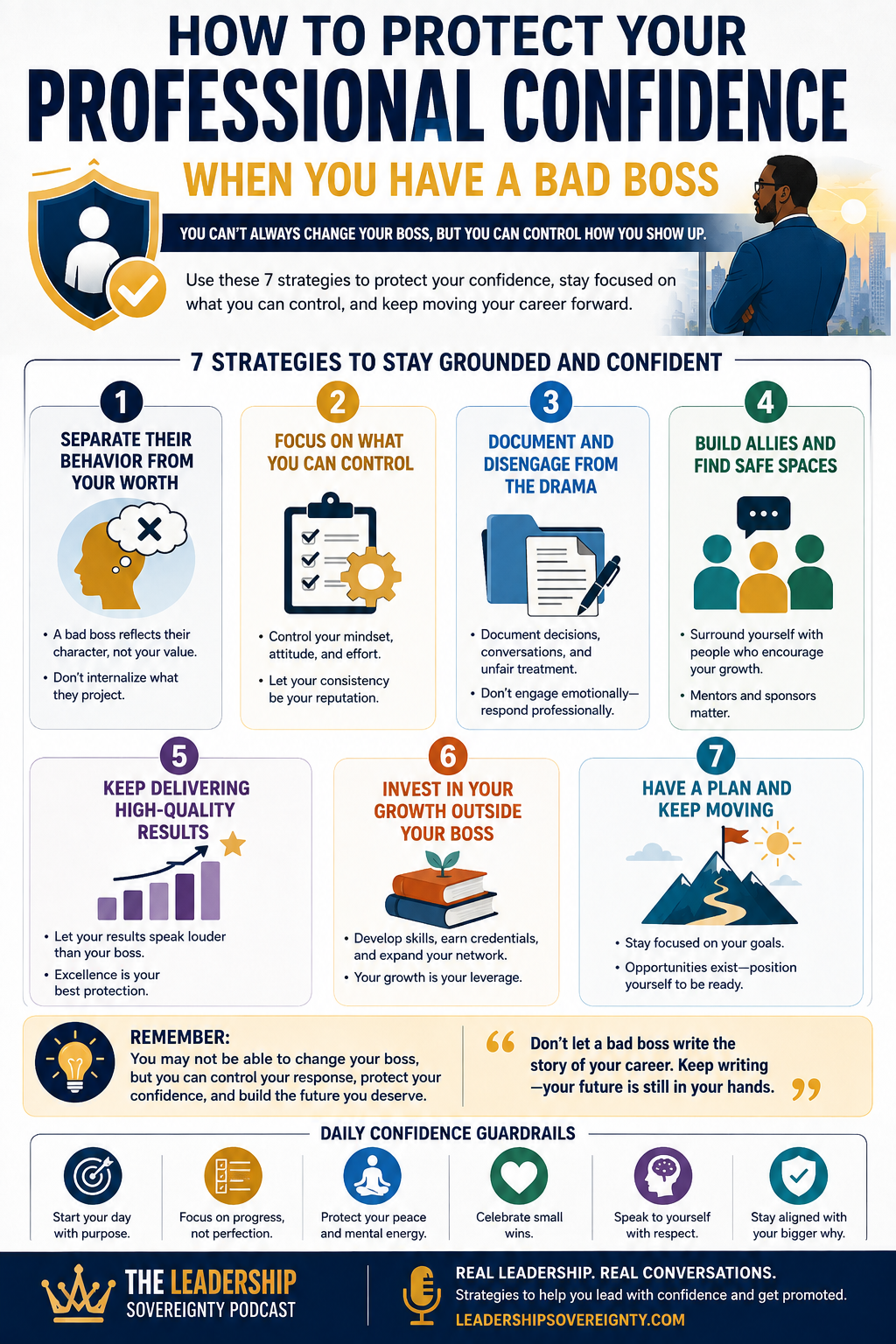
A difficult manager may influence your current environment, but they do not own your professional identity.
The goal is not to ignore legitimate feedback or avoid accountability. The goal is to build an objective view of your performance, document your contributions, develop relationships beyond one leader, and continue strengthening the capabilities that make you valuable.
The Strategy That Protects Your Confidence When Authority Fails You
Lawrence Scott shared three principles on The Leadership Sovereignty Podcast that every corporate professional should adopt immediately.
Build your own feedback loop. When you cannot trust the evaluation coming from your direct supervisor, you must create an objective, evidence-based view of your own performance. Keep a private record of your wins, project outcomes, and feedback from cross-functional peers. If your manager says your work is lacking but your data tells a different story, you have an objective conflict to resolve — and the data wins.
Find an external mentor immediately. Never rely on a single person for your entire professional development. If your current manager is failing to support you, seek out a respected leader outside your direct reporting line. Present your work. Ask for an honest assessment. One affirming voice from a credible source can undo months of damage from a dismissive one — which is exactly what happened when a philosophy professor at West Point pulled Lawrence aside and told him his writing was some of the best he had ever read. That single conversation restored what a semester of dismissiveness had nearly destroyed.
Stop managing your weaknesses and start multiplying your strengths. Lawrence put it directly: if a leader only points out your weakness, that is all you will focus on. But if you redirect your energy toward the skills that make you an asset, your value becomes undeniable regardless of your supervisor's opinion. Delegate what you struggle with. Double down on what you do best. Become so strong in your primary competencies that no single manager can define your trajectory.
Take Control of Your Professional Narrative Before Someone Else Does
The hardest leadership lesson Lawrence Scott learned at the United States Military Academy at West Point is one that applies to every corporate environment: the quality of the leader above you determines the ceiling of what you can become — unless you refuse to let it.
A bad manager can temporarily stall your progress. They cannot permanently define your identity unless you allow them to. By building independent feedback systems, seeking external validation from credible mentors, and investing relentlessly in your strengths, you insulate your confidence from institutional pressure.
Ralph E. Owens II and Terry Baylor go deeper into these strategies with Lawrence Scott on Episode 186 of The Leadership Sovereignty Podcast. If you lead people — or answer to someone who does — this is the episode that will change how you show up Monday morning.
Frequently Asked Questions
How can I tell if my manager is truly incompetent or just hard to please?
A hard-to-please manager still invests in your success. They give you difficult feedback, but it comes with specificity and a path forward. A manager who is the problem gives you vague criticism, avoids follow-up conversations, and offers no support when you ask for clarification. If you are doing the work and consistently hitting organizational goals but your manager's feedback never acknowledges that progress, you are likely dealing with a leadership deficit — not a standards gap.
What should I do if my professional confidence has already been damaged?
Step back from the immediate environment mentally. Revisit the last 12 months of your career and document every project you completed, every goal you hit, and every positive piece of feedback you received from anyone other than your direct manager. Then seek out a neutral mentor — someone with no political connection to your supervisor — and ask them to assess your work objectively. Lawrence Scott's confidence was restored at the United States Military Academy at West Point by a single professor who told him the truth about his ability. One credible voice can undo significant damage.
Is it possible to repair a relationship with a manager who has dismissed my work?
It is possible but it requires a strategic shift. Stop seeking emotional validation and pivot to business-only interactions. Explicitly ask for measurable success criteria on every assignment: what does success look like, what is the deadline, and how will completion be evaluated? If you provide those parameters and the manager still cannot give you a straight answer, you have confirmed the problem is not your performance. At that point, begin preparing for an internal transfer or external move — on your terms, not theirs.
How do I document my performance without appearing confrontational?
Frame your documentation as alignment. After every meeting, send a brief recap email summarizing decisions made, responsibilities assigned, and deadlines agreed upon. Copy relevant stakeholders when appropriate. This creates a paper trail that protects you while appearing organized and thorough. If your manager later contradicts what was discussed, you have a written record. This is not about building a legal case — it is about making sure your contributions are visible to more people than just the person who is failing to acknowledge them.
When should I stop trying to get feedback from a manager who will not provide it?
After two direct, documented requests for specific feedback that go unanswered or are met with vague generalities, stop asking. At that point, your manager has demonstrated that they are either unwilling or unable to invest in your growth. Redirect that energy toward building relationships with leaders who will. Your development cannot be held hostage by one person's refusal to lead.

Host, The Leadership Sovereignty Podcast | CIO | 2x Houston CIO of the Year Finalist | US Navy Veteran
Ralph E. Owens II is the host and executive producer of The Leadership Sovereignty Podcast, which he co-hosts with Terry Baylor. Together they have built a career acceleration platform for professionals who want to increase their influence, navigate workplace politics with integrity, and position themselves for promotion.
Ralph is a Chief Information Officer in financial services and a two-time Houston CIO of the Year finalist. His career spans financial services and energy generation, where he has secured critical infrastructure, navigated complex regulatory environments, and built high-performing teams that consistently deliver under pressure.
He is also a United States Navy veteran. Much of what he teaches about leading under pressure, and about the difference between authority and influence, started there.
He built this show for a specific reason. Most professionals are never actually taught the things that determine whether they advance. Every episode is designed to close that gap with real-world strategy rather than theory, so listeners move from overlooked to promoted.
Why Non-Technical Leaders Misunderstand AI Capabilities and File Structures