
How to Recover from Workplace Betrayal Without Letting It Stall Your Career

When a trusted leader betrays your confidence or acts with hidden ulterior motives, the professional fallout can feel utterly devastating. Recovering from workplace betrayal requires more than just brushing it off; it demands a deliberate psychological shift to ensure an unfair setback does not permanently derail your path to leadership sovereignty.
Key Takeaways
- Workplace betrayal severely fractures basic emotional needs like security, affirmation, and acceptance, making it uniquely painful to process.
- Repeatedly telling the story of how you were wronged provides a false sense of comfort and affirmation, keeping you psychologically trapped.
- Injured professionals often mistake pain for incapacitation, stopping their career progression entirely when they should be moving forward with a limp.
- Resilience requires a deeper 'why'—such as a personal sense of purpose or fear of becoming bitter—rather than just mechanical coping tactics.
- True leadership maturity involves falling out of love with the victim narrative and refusing to let someone else's unfair actions dictate your future.
Workplace Betrayal Recovery Framework
Use this six-step framework to process what happened, protect your confidence, and move forward without allowing someone else’s actions to derail your career.
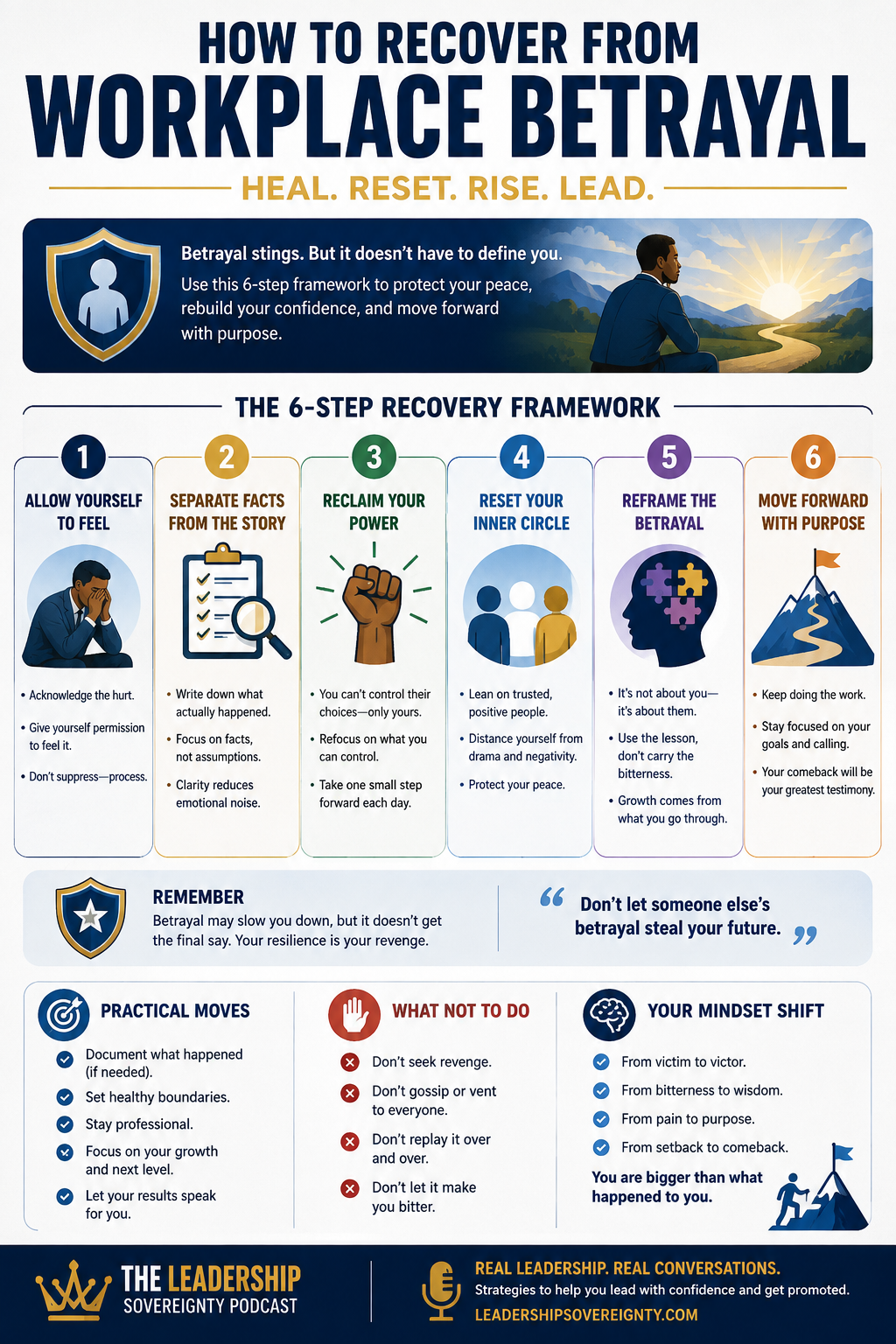
The six steps are:
- Allow yourself to feel.
- Separate facts from the story.
- Reclaim your power.
- Reset your inner circle.
- Reframe the betrayal.
- Move forward with purpose.
Save this page or share it with someone who may need a practical framework for navigating workplace betrayal.
The Anatomy of Workplace Betrayal
Every ambitious professional eventually encounters a leader they trusted implicitly, only to discover that person was playing a different game entirely. Whether it is taking credit for your work, undermining your initiatives behind closed doors, or pushing you aside after you helped them succeed, the impact goes far beyond bruised professional pride.
Betrayal cuts deep because it strikes at the core of what human beings need to thrive in any environment: security, affirmation, and acceptance. When those foundational needs are shattered by someone holding structural power over your career, your brain naturally goes into defense mode. The immediate aftermath usually involves a long, painful ride home filled with disbelief, anger, and the agonizing question of how you missed the warning signs.
Why We Get Stuck in the Victim Narrative
In the wake of professional mistreatment, it is completely natural to want to talk about what happened. You recount the events to peers, mentors, and supportive colleagues. Every time you tell the story, something specific happens: you get validation. People shake their heads, express outrage on your behalf, and affirm that you were entirely in the right.
However, this cycle creates a dangerous trap. The story becomes an altar where you seek quick hits of affirmation and security. Because the retelling always positions you as the wronged party and the other person as the villain, it feels comforting. But as leadership experts note, you cannot build a tent there. Vocalizing the betrayal is a necessary part of the initial restoration process, but it must have a beginning and an end. If you stay too long, the narrative stops being a tool for processing and starts being a prison that keeps you anchored to your trauma.
Injury Versus Incapacitation in Your Career
One of the most critical distinctions an emerging leader must learn is the difference between being injured and being incapacitated. In a demanding career, getting hurt by office politics or toxic leadership is practically inevitable. People will cross you, break promises, and act out of self-preservation at your expense.
An injury hurts. It might force you to walk with a metaphorical limp for a while, and it definitely requires time to heal. But an injury does not mean you stop breathing, and it does not mean you stop moving forward. Incapacitation, on the other hand, is when you allow that hurt to paralyze your ambitions entirely. Many professionals let a single bad boss or a painful betrayal bench them for years, effectively ending their own ascent because they refuse to step back onto the playing field.
The 'Bleed a While' Mindset
True resilience is modeled after the physical reality of human biology. When you experience a deep cut, your body bleeds. That bleeding is actually part of the healing mechanism designed to create clots and form protective scars so you can eventually get back up and fight some more.
In your career, you are allowed to bleed a while. You are allowed to take a moment to lick your wounds, process the disappointment, and grieve the loss of trust. What you cannot do is bleed out and die in that exact spot. The scars left by past betrayals should become armor, not an excuse to retreat permanently into the background.
Finding Your Why for Resilience
It is easy to offer generic advice about staying resilient, but teaching someone how to bounce back without giving them a valid reason to do so is illogical. Why would you subject yourself to a workplace that might hurt you again? Why push for that promotion or try to influence another difficult leader if the environment itself feels hostile?
Resilience requires a deeply personal reason—a 'why' that outweighs the risk of future pain. For many, that reason is tied to a God-given dream, a sense of purpose, or a commitment to the people they are ultimately called to serve. Furthermore, you can hack your own mindset by shifting your fears. Instead of being paralyzed by the fear of what happens if you try again and fail, fear the alternative: ask yourself who you will become if you don't act. If you let bitterness, resentment, and cynicism take root because of one bad leader, you run the risk of becoming the very type of toxic professional you despise.
Conclusion
Navigating the complex waters of corporate politics and upward influence means you will inevitably encounter friction, and occasionally, outright betrayal. How you respond to those moments defines your trajectory as a leader. By falling out of love with your victim story, treating setbacks as injuries rather than incapacitations, and anchoring your resilience to a clear purpose, you can turn workplace adversity into your greatest foundation for growth.
For deeper strategies on mastering the dynamics of your career and learning how to effectively navigate workplace relationships, Listen to the full episode of the Leadership Sovereignty Podcast. Subscribe, leave a review, and continue leading with purpose and sovereignty.
Frequently Asked Questions
Why is workplace betrayal so difficult to bounce back from compared to normal professional setbacks?
Workplace betrayal fractures foundational emotional needs such as security, affirmation, and acceptance. When a leader you trust turns out to have ulterior motives, it violates your sense of safety in the organizational hierarchy, triggering a deeper emotional wound than a standard missed promotion or project failure.
How do I know if I am treating a workplace injury as a career incapacitation?
If a past betrayal or unfair treatment has completely halted your willingness to take risks, share new ideas, or pursue promotions, you are treating an injury as an incapacitation. Being injured means you might walk with a limp and need time to heal, but you continue to move forward and do your work.
What does it mean to 'fall out of love with the story' of how you were wronged?
Falling out of love with your victim story means recognizing that while retelling the story of your betrayal offers temporary emotional comfort and validation, it ultimately keeps you anchored to the past. Healing requires acknowledging the event, processing it, and consciously choosing to stop building your identity around being wronged.
How can I find the motivation to stay resilient after being burned by a leader?
Resilience cannot be sustained by mere techniques; it requires a powerful 'why.' You must connect to your core sense of purpose or recognize the alternative: if you let bitterness take root, you risk becoming the very cynical, toxic professional you despise. Protecting your own character provides the necessary fuel to keep fighting for your career.

Host, The Leadership Sovereignty Podcast | CIO | 2x Houston CIO of the Year Finalist | US Navy Veteran
Ralph E. Owens II is the host and executive producer of The Leadership Sovereignty Podcast, which he co-hosts with Terry Baylor. Together they have built a career acceleration platform for professionals who want to increase their influence, navigate workplace politics with integrity, and position themselves for promotion.
Ralph is a Chief Information Officer in financial services and a two-time Houston CIO of the Year finalist. His career spans financial services and energy generation, where he has secured critical infrastructure, navigated complex regulatory environments, and built high-performing teams that consistently deliver under pressure.
He is also a United States Navy veteran. Much of what he teaches about leading under pressure, and about the difference between authority and influence, started there.
He built this show for a specific reason. Most professionals are never actually taught the things that determine whether they advance. Every episode is designed to close that gap with real-world strategy rather than theory, so listeners move from overlooked to promoted.

Why Employees Hate Project Management Tools (And How to Fix It)