
How to Lead a Team You Inherited Without Repeating What Broke It
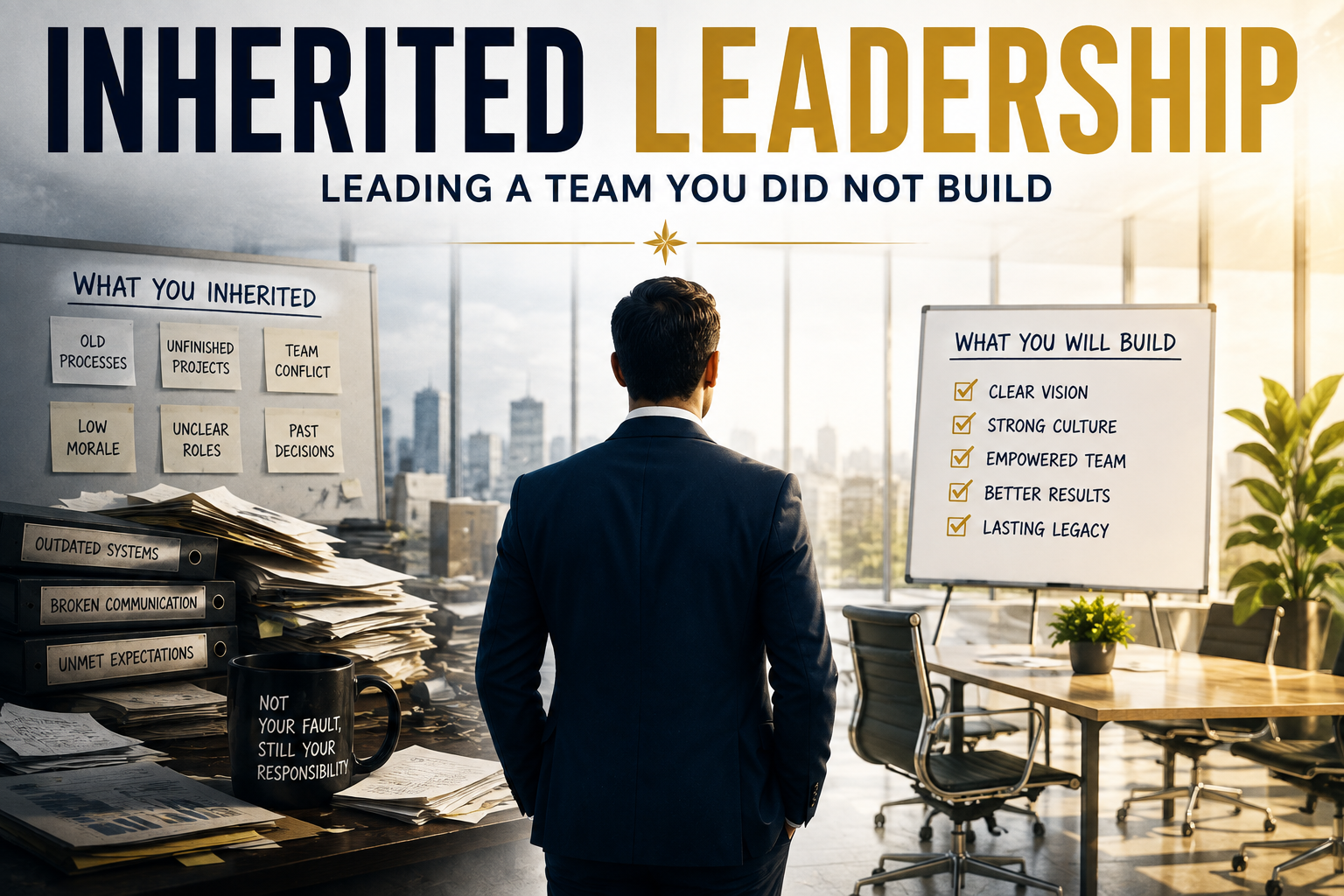
You did not build the team you lead. You inherited it. You inherited the systems, the unwritten rules, the unresolved conflicts, and the decisions someone else made long before your name was on the door. Not your fault. Still your responsibility.
On EP188 of The Leadership Sovereignty Podcast, host Ralph E. Owens II and co-host Terry Baylor continue an ongoing conversation with Lawrence Scott, a graduate of the United States Military Academy at West Point, a former Army officer, and a certified member of the John Maxwell Team. Lawrence is a fifth generation inheritor of public leadership, and he has spent his life watching what transfers cleanly from one leader to the next and what quietly does not. This conversation is about the moment most professionals never get trained for: the day you take the role, and the problems that came with it are suddenly yours to answer for.
Key Takeaways
- You are not responsible for fixing what a previous leader broke, unless fixing it is the assignment you were hired to do.
- Walking in as the corrector makes you harsh, makes you critical, and quietly dishonors the person who helped put you in the seat.
- Successful succession happens before the handoff. If the outgoing leader has nowhere to go, the incoming leader never gets free.
- Some leadership transfers by observation. Some of it never does, and has to be explicitly taught with the reasoning said out loud.
- The standard is not comfort. If you are not doing better than the person before you, you are not honoring their legacy.
The Problem: You Inherited a Team You Did Not Build
Every promotion comes with a story that started before you arrived. The process that makes no sense was designed to solve a problem that no longer exists. The two people who will not work together have a history nobody wrote down. The tool everyone complains about was chosen by someone who is no longer here to defend it.
So you arrive, and within a few weeks you are carrying a question you cannot put down: how much of this is now mine to fix?
Most capable professionals answer that question the same way. They decide all of it is theirs. It feels like ownership. It feels like the responsible posture. It is also the fastest way to burn credibility in the first ninety days, because a leader who treats the inheritance as a mess to be corrected is a leader who is implicitly grading the person who came before, in front of a team that may still be loyal to them.
Lawrence Scott names this directly. His starting point is that you are not responsible for fixing what they broke, and he explains what happens when you assume otherwise. "Whenever you take on that disposition, you come in often far too harsh, far too critical, and you don't intend to do this, but in that disposition, you actually dishonor them."
That is the trap. The intent is ownership. The effect is judgment. And the team reads the effect, not the intent.
But this is not a permission slip. Lawrence holds the other end of the standard just as firmly, and it comes from his own family line: "if you're not doing better than your parent or your grandparent, then you're not honoring their legacy." You are not obligated to repair what someone else broke. You are obligated to not repeat it, and to exceed it.
He also gives the sharpest image in the episode for what inheriting really means. "If you're gonna stand on the shoulders of giants, you better make sure that whatever part of that shoulder you stepped on is solid." The people who built what you inherited were giants. They were not gods. As Lawrence puts it about his own great grandfather, he was a giant, but he was not God. He made mistakes, and some of what he built was built on shaky foundations, because he was limited in his capacity and his exposure. Every leader is. Including you. Including the person who follows you.
Your job is not to grade the foundation. Your job is to test the specific part of it you are about to put your full weight on.
The Framework: Three Strategies for Leading What You Inherited
These three moves come directly out of the conversation. Run them in order. They are designed to take you from inherited confusion to a defined assignment inside the first month in the role.
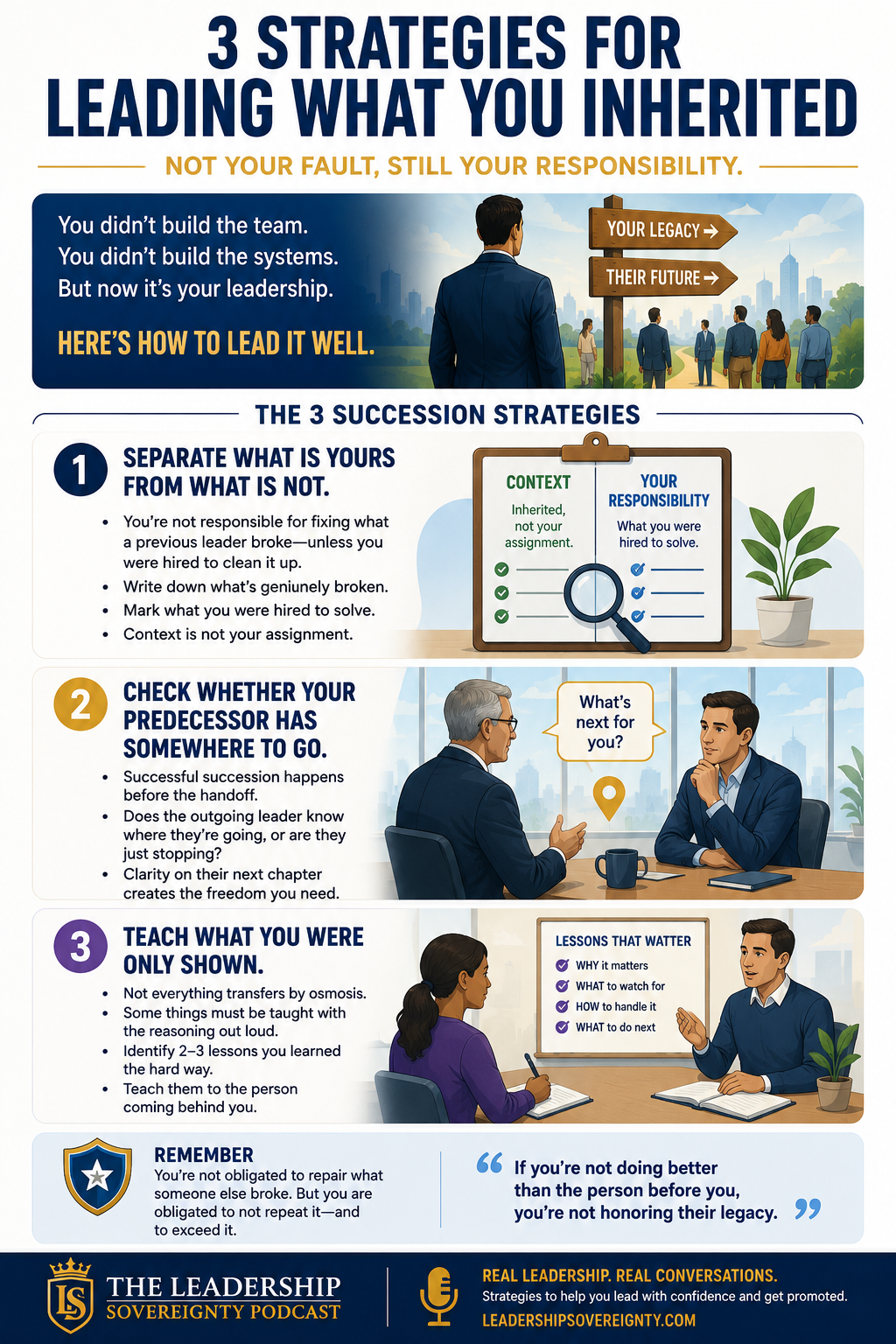
Three strategies for leading a team you inherited, from The Leadership Sovereignty Podcast: separate what is yours from what is not, check whether your predecessor has somewhere to go, and teach what you were only shown.
1. Separate what is yours from what is not
Context is not the same thing as assignment. The history you walked into is context. What you were hired to solve is your assignment. Most new leaders collapse the two, and then spend a year exhausted by work nobody actually asked them to do.
Lawrence draws the line with a clean exception. You are not responsible, he says, unless you are. If you were brought in specifically because the last leader broke something, then repairing it is the job and you should distance yourself from the old approach deliberately. That is a turnaround mandate, and it is rare. Ordinary succession is the far more common case, and it works differently.
Do this in writing, this week:
- List everything that is genuinely broken in what you inherited. All of it. Do not filter yet.
- Mark only the items you were actually hired to solve. If you cannot point to the conversation, the job description, or the mandate where that item was named, it is context, not assignment.
- Take the unmarked items to your own leader and ask one question: which of these do you expect me to own this year?
- Everything still unclaimed after that conversation gets managed, not fixed. You keep it running. You do not rebuild it on your own time.
The value of writing it down is that it converts a vague sense of guilt into a short, defensible list. You stop apologizing for a history you did not create, and you start being measured on the work you were actually given.
2. Check whether your predecessor has somewhere to go
This is the strategy almost nobody plans for, and it determines how much room you will actually have.
Lawrence puts the principle plainly: "successful succession happens before it happens." The question is not whether the outgoing leader signed the handover. The question is whether they know where they are going next. "In the exception of death, leaders have to have a next thing to do. If they don't, then you won't have the level of freedom that you think you'll need in order to really accomplish what you need to accomplish."
He has watched this play out inside his own family. When the handoff happened after a death, the documents were in place and the transition was clean. When the handoff happened while the outgoing leader was still present and still without a next chapter, the incoming leader took the title but never felt free enough to do the things he actually wanted to do.
The military solves this structurally. When an officer leaves a post, the Army does not leave them nearby. As Lawrence describes it, they move you out of the entire unit, because what the institution does not want is for people's affections to stay attached to the previous leader. When affection stays, people route around the new systems and go back to the old person, and it feels like loyalty. It is not. It holds back the very legacy everyone thinks they are protecting.
What to do with this if you are the one arriving:
- Ask the outgoing leader directly what is next for them. Not as a courtesy. As reconnaissance.
- If the answer is vague, expect a period where decisions still get relitigated through them, and plan your first wins in areas they were never emotionally invested in.
- Watch the routing. When people bring a question to your predecessor instead of to you, that is not a personality problem. That is an unfinished succession.
- Honor them loudly and publicly while you redirect the traffic. Those two things are not in conflict, and doing only one of them fails.
3. Teach what you were only shown
The third strategy is the one that decides whether the person after you inherits a working system or a repeat of your own first year.
Lawrence traces a four generation pattern in his own family. There were things his great grandfather did that his grandfather saw but was not taught. Things his grandfather did that his father saw but was not taught. Things his father does that he sees but is not taught. His conclusion is the line every leader building a bench needs: "So some things are taught, other things are caught, but there's certain things about leadership and influence that must be taught."
Proximity is not instruction. Sitting in the room while a decision is made does not transfer the reasoning behind the decision. Most succession failures are not failures of talent. They are failures of translation, where the person coming behind absorbed the behavior and never received the logic.
Make it concrete:
- Name the two or three lessons you learned the hard way in this role. The ones that cost you something.
- For each one, say the four parts out loud to the person coming behind you: why it matters, what to watch for, how to handle it, and what to do next.
- Do it before you need to. Teaching under the pressure of your own exit is too late.
- Write the reasoning down somewhere durable. Your successor will inherit the document long after they stop being able to ask you.
Ownership: The Standard You Are Actually Being Held To
There is a version of this message that gets misused, and it is worth closing that door before it opens. "You are not responsible for what they broke" is not cover for coasting. It is a scoping instruction, not an exemption.
The standard underneath all three strategies is the one Lawrence applies to himself and to everyone he coaches. If you are not doing better than the person before you, you are not honoring their legacy. Not as a criticism of them, but because of everything they were able to sow into you. You should be able to go a little bit higher.
That standard reaches past the org chart and into how you treat the people you inherited. Lawrence frames leadership as influence, and influence as something that has to move in a direction. "if I'm not influencing you toward your best self and toward the thing that you've been put on earth to do, the thing that provides you with significance and fulfillment, then I'm actually not leading you, I'm using you."
That is the difference between a leader who inherits people and a leader who inherits headcount. He pushes it one step further into how you build teams at all. Convincing someone to join you only holds them for as long as they stay convinced. "Compulsion is not convincing." The leaders worth following showed proof of concept first and let people decide to move toward it.
And the standard is ultimately about what people will say about you when you are not in the room. Lawrence tells a story about his great grandfather, a St. Louis leader whose buildings people traveled to see. The stories that survived were not about the buildings. One man told him that he used to drive the Bishop around the city, that he would leave the house with five thousand dollars in his pocket and come home with none of it, and that when he asked why he carried that much money through the city, the answer was "the needs are great."
Nobody tells stories about the process you streamlined. They tell stories about who you were while you were doing it.
So take the inventory. Scope the assignment. Find out where your predecessor is headed. Then teach the person behind you the reasoning, not just the behavior. You did not build what you walked into. What gets built next is yours.
Ralph E. Owens II and Terry Baylor sit down with Lawrence Scott for this conversation on EP188 of The Leadership Sovereignty Podcast. You can also view Lawrence Scott's guest profile or connect with his coaching practice.
What did you inherit at work that you are still deciding whether to fix, and what would change if you scoped it this week?
Frequently Asked Questions
Am I responsible for fixing problems I inherited from a previous leader?
Only where fixing them is the assignment you were hired to do. Lawrence Scott's position is that you are not responsible for repairing what a predecessor broke unless repair is the mandate, as it would be for a leader brought in specifically to turn a situation around. In ordinary succession, the history you walked into is context. Write down what is genuinely broken, mark only what you were hired to solve, and confirm the rest with your own leader before you start rebuilding anything.
How do I lead a team I did not build without insulting the person before me?
Stop treating the inheritance as a mess to be corrected. Taking on the posture of corrector makes new leaders too harsh and too critical, and the team reads that as judgment of a leader many of them still respect. Lead by improving forward rather than auditing backward, and be explicit and public about what the previous leader built well. Improvement is the honor. Criticism is not.
What makes succession planning actually work?
Successful succession happens before the handoff, and the deciding factor is whether the outgoing leader has a defined next chapter. When they do not, they stay involved, people keep routing decisions through them, and the incoming leader never gets the freedom the role requires. The military manages this structurally by reassigning departing leaders out of the unit entirely, so affections and authority move together.
What is the difference between leadership that is taught and leadership that is caught?
Caught leadership is absorbed by watching someone lead over time, without instruction. Taught leadership is explained, including the reasoning behind the decision. Lawrence Scott's argument is that certain principles never reliably transfer through observation alone, which is where most succession quietly breaks down. If it matters, say it out loud: why it matters, what to watch for, how to handle it, and what to do next.
How do I know if I am leading my team or just using them?
Ask what direction your influence is moving them in. If you are moving people toward their own best work and their own sense of purpose while staying aligned to the organization, you are leading them. If you are extracting skill toward the corporate result with no regard for where it leaves them, you are using them, and they will figure it out. Leaders who last build compelled teams, not convinced ones.
Related Blog Posts
- How to Recover from Workplace Betrayal Without Letting It Stall Your Career, EP187 with Lawrence Scott
- Protecting Your Professional Confidence When Your Manager Undermines Your Work, EP186 with Lawrence Scott
- The Prudent Man Model: Scaling Character Beyond Your Position

Host, The Leadership Sovereignty Podcast | CIO | 2x Houston CIO of the Year Finalist | US Navy Veteran
Ralph E. Owens II is the host and executive producer of The Leadership Sovereignty Podcast, which he co-hosts with Terry Baylor. Together they have built a career acceleration platform for professionals who want to increase their influence, navigate workplace politics with integrity, and position themselves for promotion.
Ralph is a Chief Information Officer in financial services and a two-time Houston CIO of the Year finalist. His career spans financial services and energy generation, where he has secured critical infrastructure, navigated complex regulatory environments, and built high-performing teams that consistently deliver under pressure.
He is also a United States Navy veteran. Much of what he teaches about leading under pressure, and about the difference between authority and influence, started there.
He built this show for a specific reason. Most professionals are never actually taught the things that determine whether they advance. Every episode is designed to close that gap with real-world strategy rather than theory, so listeners move from overlooked to promoted.

How to Recover from Workplace Betrayal Without Letting It Stall Your Career